Overview
Mouse over pulsing icons for more information…
Tarkwa Mine: A Strong Operation with Opportunities for Improvement
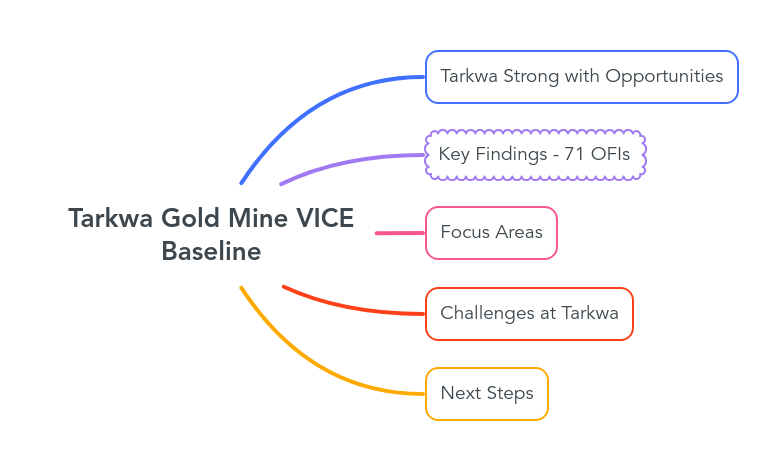
Tarkwa Mine is a well-managed, productive operation with robust practices that align with industry standards. The VICE Baseline confirms that site processes are well-documented, implemented effectively, and generally reliable.
Key Findings: 71 Opportunities for Improvement (OFIs)
Despite its strong foundation, the review identified 72 OFIs, highlighting:
- Gaps Between Intent and Practice: Discrepancies between documented procedures ("work as documented") and real-world execution ("work as done").
- Commitment to Excellence: Many OFIs build on current practices, reflecting the dedication of participants to drive continuous improvement.
Focus Areas for Improvement
A structured, iterative approach is needed to address OFIs, emphasizing relevance, practicality, and value-add Key focus areas include:
- Road Design and Maintenance: Review intersection standards and haul road construction/maintenance protocols.
- Communication Practices: Enhance positive communication protocols for vehicle interactions.
- Operational Consistency: Address equipment selection, planning, and system design gaps.
Challenges at Tarkwa
Tarkwa’s incident patterns and OFIs differ from similar mines, potentially due to its integrated contractor model and underreporting of non-equipment damage incidents.
Next Steps
Senior management should appoint review teams to review the opportunities for improvement summarised in Section 2 of this report with full details available on the Tarkwa Mine Knowledge and Performance Platform.
The 5 Pillars of Safe and Productive Operation
Mouse over pulsing icons for more information…
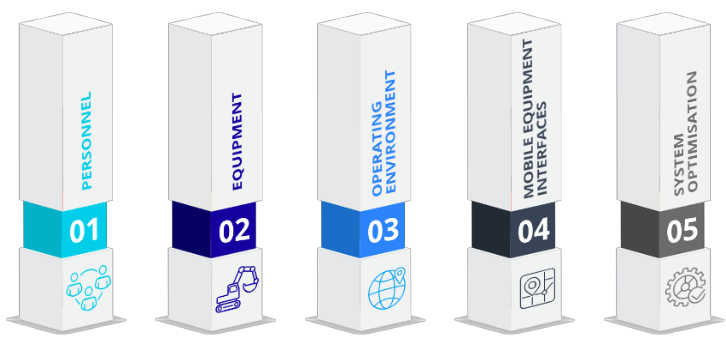
Operators and all people working around mobile equipment are trained, competent, authorised, informed, alert, and situationally aware.
These business inputs focus on ensuring:
- Operators of mobile equipment are well-trained, competent, authorized, and stay aware of their surroundings.
- Workers regularly near mobile equipment are trained, competent, authorized, informed, and alert.
- Visitors to areas with mobile equipment are properly supervised, authorized, and remain alert and aware of their surroundings.
- Supervisors clearly communicate mobile equipment tasks and safety requirements to workers.
- Mobile equipment operations are regularly checked to stay safe and productive, with potential risks (like fatigue or loss of focus) identified and managed.
Equipment Pillar: Mobile Equipment is fit for use, key systems are functioning.
These business inputs focus on ensuring:
- Mobile equipment is fit-for-purpose and ready for safe use.
- Equipment is maintained to stay safe and productive during operations.
- Supporting systems, like radio communications, are suitable and remain in good working order.
- Equipment failures are reported quickly and managed effectively to reduce risks and downtime.
Operating Environment for mobile equipment is satisfactory; hazards are identified and managed.
These business inputs focus on:
- Setting standards and rules for designing and building safe operating environments for mobile equipment.
- Maintaining the work environment, including:
- Gradients, road surfaces, drainage, lighting, signage, barriers, and segregation of people and vehicles.
- Establishing processes to manage changes in operating conditions, like weather or unexpected hazards.
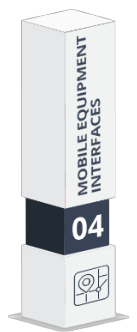
Mobile Equipment interfaces with pedestrians and other vehicles are well managed.
These business inputs focus on managing interactions involving mobile equipment, including:
- Pedestrian safety around mobile equipment.
- Vehicle-to-vehicle interactions to prevent accidents.
- Road design features like parking and restricted (quarantine) areas to improve safety.
- Clear standards and rules for safe and efficient operations between workgroups in all situations.
- Protocols for maintenance and service tasks in operational areas, including refueling.
System Level Optimisation Pillar: Coordinated and Integrated Vehicle Interaction Management
This group of business inputs ensures mobile equipment operations are safe, productive, and fully integrated into everyday business and operational processes. It focuses on having a system-wide view of activities and making adjustments when needed.
These business inputs help sites by ensuring:
- Operators of mobile equipment are trained, competent, authorized, informed, alert, and aware of their surroundings.
- Workers near mobile equipment are trained, competent, authorized, alert, and situationally aware.
- Work environments are designed to minimize errors as much as possible.
- Mobile equipment interactions are reviewed regularly during production planning and scheduling.
- Equipment operations are monitored and adjusted to stay safe and productive.
Summary of the key Opportunities for Improvement
The following sections present a summary of the opportunities for improvement – organised by the key pillars of safe production. Note that the sections are presented in the suggested priority order by which they should be addressed.
Pillar 3 - Operating Environment

- Road and Intersection Design, Construction, and Maintenance
- Review site standards and practices for intersection, haul road, and ramp design, construction, handover, maintenance, inspection, and repair. Include:
- –Signage, lighting, and delineators
- –Vegetation control
- Review site standards and practices for intersection, haul road, and ramp design, construction, handover, maintenance, inspection, and repair. Include:
- Parking Infrastructure
- Review parking area design, construction, and maintenance, consider options to reduce congestion beside light vehicle parks
- Management of Operating Environment Hazards
- Develop an assessment for in-pit lighting
- Changes in Conditions
- Review how changed operating conditions are reported and communicated,
- Review and update site trigger action response plans TARPs coordinate across Business Partners e.g. for electrical storms and ceasing operations processes
- Other Operating Environment Opportunities
- Processes for communicating speed limits and monitoring performance
Pillar 4 - Work Group Interfaces
- Planning, Schedule and Shift-to-Shift Briefings
- Review short-term operational planning processes to reduce congestion e.g. between drill and blast and load and haul.
- Operational Practice
- Review site processes for breakdowns, maintenance, and servicing work in operational areas clearance to enter, area delineation, approaching parked heavy vehicles, etc.
- Review site escort and towing processes
- Review processes for managing non-standard loads.
- Review processes for managing access e.g. availability of signs
- Confirm site minimum standards for positive communications including requirements for radios, managing pedestrians, and performance monitoring.
- Review light vehicle access permissions
- Review site refueling practices – location, communication, and spotters
- Access Control and Exclusion Zones
- Review management of pedestrians in operating areas e.g. for excavator access
- Review protocols
- Vehicle Interaction Monitoring
- Develop the use case to leverage installed and planned updates to CAS technology to advise on detected object type e.g. pedestrian, light vehicle, ancillary etc.
- Explore options to leverage data e.g. operational logs of vehicle approaches, heat maps, vehicle category and location etc.
- Other Workgroup Interaction Opportunities
- Link workshop outcomes to CAS and OAS technology projects
Pillar 1 - Personnel

- Selection, Onboarding, Inductions and Training
- Consult with all stakeholders to confirm alignment between training content and operational practice e.g. for Positive Communications
- Consider technology options to improve quality and efficiency of refresher training e.g. OAS and PDS technology equivalents on mobile equipment simulator
- Review site processes for selecting and retaining experienced maintainers and planners
- Support Information, Instructions, and Briefings
- Adapt visual reference training information to all operators and personnel who work around mobile equipment covering:
- Role and responsibilities e.g. equipment pre-start checks, defect reporting, positive communication requirements, hazard reporting etc.
- Equipment features e.g. alerts and alarms, equipment blind spots, tyre hazard management, OEM technology features and defect management
- Operating environment management e.g. mine speed limits, parking in any situation, managing road works, bunding standards, managing road works etc.
- Emergency response covering incidents, mobile equipment fires, storms etc.
- Adapt visual reference training information to all operators and personnel who work around mobile equipment covering:
- Fitness for Work
- Review Tarkwa shift rosters and processes for assessing cumulative hours
- Review practical responses for fatigued operators e.g. rest rooms
- Performance Management
- Workshop close out comment – more active supervisor performance management required
- Other Personnel Opportunities
- Involve mobile equipment operators in preparing functional requirements, project planning and deployment of upgraded OAS and PDS technologies.
Pillar 2 - Equipment

- Human Systems Integration
- Confirm that the ergonomic layout of operator displays in vehicle cabins meets the site specifications.
- Equipment Selection and Site Use Approval
- Review site processes for specifying, selecting, and approving mobile equipment for site use.
- Confirm technology installation standard
- Equipment identification standards
- Review site processes for specifying, selecting, and approving mobile equipment for site use.
- Maintenance
- Review effectiveness of maintenance backlog management, consider in field inspections to prepare for scheduled maintenance
- Review maintenance planning and the effective use of maintenance windows
- Operator Checks and Defect Management
- Review mobile equipment prestart checks defect classifications including non-OEM technologies.
- Confirm response process for alerts and alarms
- Review radio check processes
- Other Equipment Opportunities
- Review equipment standards for headlights – new LEDs shadow reports
- Review frequency of mobile equipment alarm checks
- Leverage mobile equipment performance information
- Communications infrastructure and network reliability
Pillar 5 - System Optimisation

- Leadership Intent and Accountability
- Review, update, and apply the Tarkwa Traffic Management Plan
- Improve the understanding and application of site mining standards and procedures e.g. for Road Construction and Maintenance
- Engagement and Consultation
- Improve change management consultation and communication e.g. on Traffic Management plan requirements, and selection of new equipment for use on site
- Supporting Systems
- Review site emergency capability, manning, equipment, training, periodic exercises etc.
- Review the effectiveness of change management processes for new equipment
- Review incident management processes – communicating learnings
- Review and align mining operations inspections and task observation processes.
- Governance and Assurance
- Confirm that experienced senior managers have oversight of site Traffic Management Plans
- Improvement Planning and Leveraging Technology
- Confirm and Communicate Plan and Timelines for CAS installation
- Explore if CAS technology, or technology combinations such as CAS and Dispatch can be used to identify different subsets of vehicle interactions
- Apply VICE review outcomes to leverage outcomes from CAS and OAS technology projects e.g. heatmaps, alert discernments etc.