Menu
Coronado Global NCOC Incident Analysis
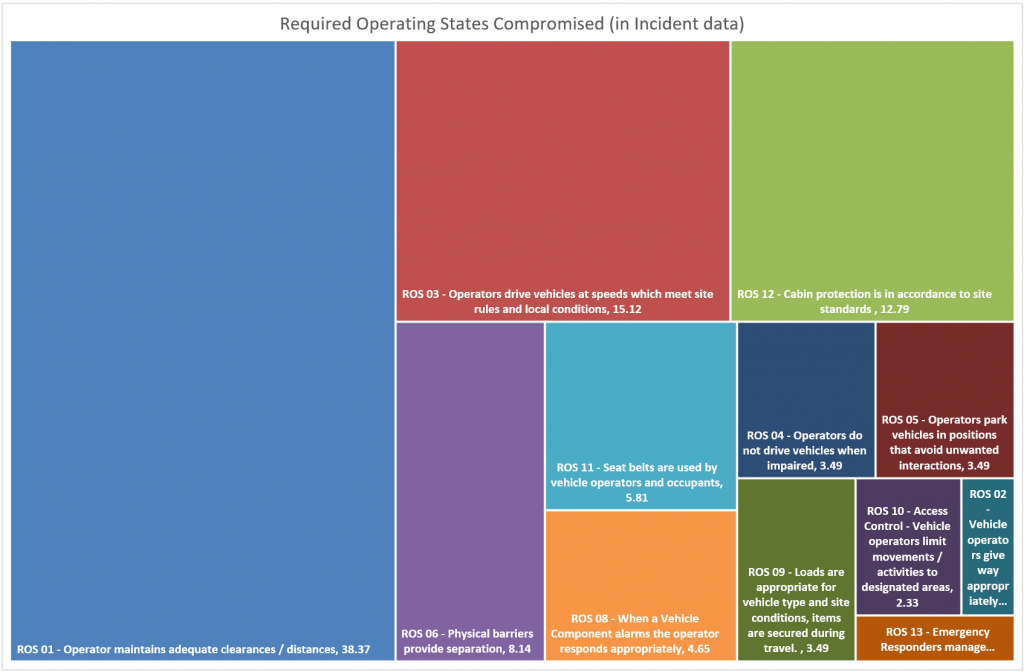
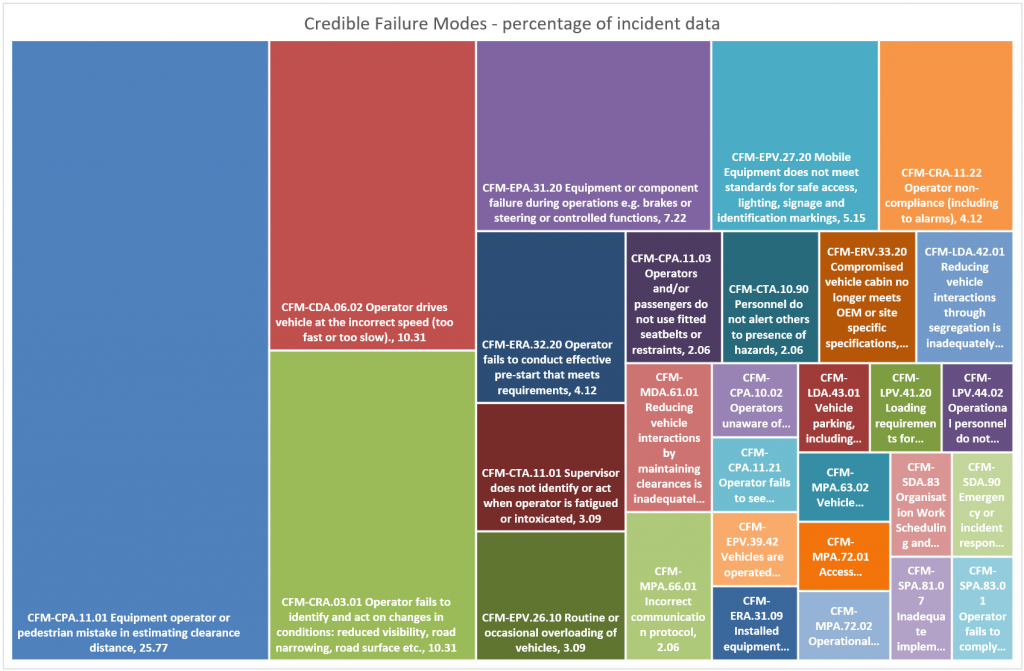
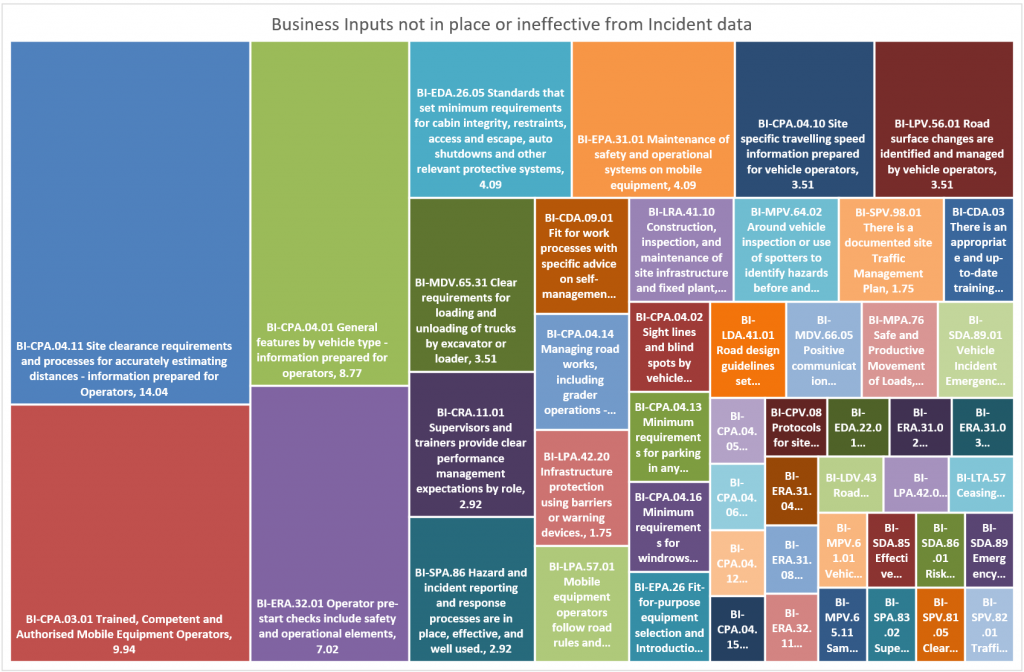
The following charts and tables present the results of the incident analysis conducted as a part of the VICE Baseline validation process. Key observations by Risk Mentor of the incident data are:
- The total number of reported incidents is higher than other, similar sized, mining operations – which is a positive indication of a strong reporting culture on site (or a site that suffers from more incidents than other, similar sites),
- The proportion of ROS 01 – Vehicle Operators Maintain Adequate Clearance is similar to other operations but the higher frequency of ROS 12 – Cabin Protection may be an indicator of worse road conditions or operating practices (operators injured due to high accelerations in the cabin, and impacts during loading)
- Failure modes that were noted to be different include a lower than usual (although still the single most significant) frequency of CFM-CPA.11.01 Clearance Distance estimation errors, and higher than typical frequency of CFM-EPV.27.20 Mobile Equipment not meeting site standards,
- No unique failure modes were identified for Curragh North Open Cut Mine – which indicates the control framework model is applicable for the site,
- In terms of Business Inputs – most are in line with similar analyses at other sites – but the frequency of BI-ERA.32.01 Operator pre-starts is higher – due to failed components identified as causal and failure to adequately inspect work environments before commencing work being more common in the incident data set.
Data in detail
Click on the arrows on the left of each point in the section below to expand or collapse the data table.
CG CNOC Required Operating States compromised in Incident Data
| Required Operating State | Percentage of Incidents |
|---|---|
| ROS 01 – Operator maintains adequate clearances / distances | 38.37 |
| ROS 03 – Operators drive vehicles at speeds which meet site rules and local conditions | 15.12 |
| ROS 12 – Cabin protection is in accordance to site standards | 12.79 |
| ROS 06 – Physical barriers provide separation | 8.14 |
| ROS 11 – Seat belts are used by vehicle operators and occupants | 5.81 |
| ROS 08 – When a Vehicle Component alarms the operator responds appropriately | 4.65 |
| ROS 04 – Operators do not drive vehicles when impaired | 3.49 |
| ROS 05 – Operators park vehicles in positions that avoid unwanted interactions | 3.49 |
| ROS 09 – Loads are appropriate for vehicle type and site conditions, items are secured during travel. | 3.49 |
| ROS 10 – Access Control – Vehicle operators limit movements / activities to designated areas | 2.33 |
| ROS 02 – Vehicle operators give way appropriately to mobile plant and pedestrians | 1.16 |
| ROS 13 – Emergency Responders manage injuries at the scene | 1.16 |
CG CNOC Credible Failure Modes present in Incident Data
| Credible Failure Mode Name | Percentage of Incidents |
|---|---|
| CFM-CPA.11.01 Equipment operator or pedestrian mistake in estimating clearance distance | 25.77 |
| CFM-CDA.06.02 Operator drives vehicle at the incorrect speed (too fast or too slow). | 10.31 |
| CFM-CRA.03.01 Operator fails to identify and act on changes in conditions: reduced visibility, road narrowing, road surface etc. | 10.31 |
| CFM-EPA.31.20 Equipment or component failure during operations e.g. brakes or steering or controlled functions | 7.22 |
| CFM-EPV.27.20 Mobile Equipment does not meet standards for safe access, lighting, signage and identification markings | 5.15 |
| CFM-CRA.11.22 Operator non-compliance (including to alarms) | 4.12 |
| CFM-ERA.32.20 Operator fails to conduct effective pre-start that meets requirements | 4.12 |
| CFM-CTA.11.01 Supervisor does not identify or act when operator is fatigued or intoxicated | 3.09 |
| CFM-EPV.26.10 Routine or occasional overloading of vehicles | 3.09 |
| CFM-CPA.11.03 Operators and/or passengers do not use fitted seatbelts or restraints | 2.06 |
| CFM-CTA.10.90 Personnel do not alert others to presence of hazards | 2.06 |
| CFM-ERV.33.20 Compromised vehicle cabin no longer meets OEM or site specific specifications | 2.06 |
| CFM-LDA.42.01 Reducing vehicle interactions through segregation is inadequately considered in mine design and work planning | 2.06 |
| CFM-MDA.61.01 Reducing vehicle interactions by maintaining clearances is inadequately considered routine work planning | 2.06 |
| CFM-MPA.66.01 Incorrect communication protocol | 2.06 |
| CFM-CPA.10.02 Operators unaware of give way requirements for light vehicles | 1.03 |
| CFM-CPA.11.21 Operator fails to see signage installed to standard | 1.03 |
| CFM-EPV.39.42 Vehicles are operated outside specified tyre conditions | 1.03 |
| CFM-ERA.31.09 Installed equipment system status alarms do not operate | 1.03 |
| CFM-LDA.43.01 Vehicle parking, including emergency parking is inadequately considered in mine design and routine work planning | 1.03 |
| CFM-LPV.41.20 Loading requirements for vehicles inadequately considered in mine design, equipment selection and work planning | 1.03 |
| CFM-LPV.44.02 Operational personnel do not maintain minimum standards for berms, windrows and other zone protection. | 1.03 |
| CFM-MPA.63.02 Vehicle operator does not check pathway after being parked | 1.03 |
| CFM-MPA.72.01 Access control infrastructure is inadequate | 1.03 |
| CFM-MPA.72.02 Operational access control (pedestrian and vehicle) is inadequate | 1.03 |
| CFM-SDA.83 Organisation Work Scheduling and Planning is inadequate | 1.03 |
| CFM-SDA.90 Emergency or incident response is inadequate | 1.03 |
| CFM-SPA.81.07 Inadequate implementation of site traffic management plan | 1.03 |
| CFM-SPA.83.01 Operator fails to comply with site requirements | 1.03 |
CG CNOC Business Inputs deficient in Incident Data
| Business Input | Percentage of Incidents |
|---|---|
| BI-CPA.04.11 Site clearance requirements and processes for accurately estimating distances – information prepared for Operators | 14.04 |
| BI-CPA.03.01 Trained, Competent and Authorised Mobile Equipment Operators | 9.94 |
| BI-CPA.04.01 General features by vehicle type – information prepared for operators | 8.77 |
| BI-ERA.32.01 Operator pre-start checks include safety and operational elements | 7.02 |
| BI-EDA.26.05 Standards that set minimum requirements for cabin integrity, restraints, access and escape, auto shutdowns and other relevant protective systems | 4.09 |
| BI-EPA.31.01 Maintenance of safety and operational systems on mobile equipment | 4.09 |
| BI-CPA.04.10 Site specific travelling speed information prepared for vehicle operators | 3.51 |
| BI-LPV.56.01 Road surface changes are identified and managed by vehicle operators | 3.51 |
| BI-MDV.65.31 Clear requirements for loading and unloading of trucks by excavator or loader | 3.51 |
| BI-CRA.11.01 Supervisors and trainers provide clear performance management expectations by role | 2.92 |
| BI-SPA.86 Hazard and incident reporting and response processes are in place, effective, and well used. | 2.92 |
| BI-CDA.09.01 Fit for work processes with specific advice on self-management | 1.75 |
| BI-CPA.04.14 Managing road works, including grader operations – information prepared for operators | 1.75 |
| BI-LPA.42.20 Infrastructure protection using barriers or warning devices. | 1.75 |
| BI-LPA.57.01 Mobile equipment operators follow road rules and adjust based on conditions and circumstances. | 1.75 |
| BI-LRA.41.10 Construction, inspection, and maintenance of site infrastructure and fixed plant | 1.75 |
| BI-MPV.64.02 Around vehicle inspection or use of spotters to identify hazards before and during movement | 1.75 |
| BI-SPV.98.01 There is a documented site Traffic Management Plan | 1.75 |
| BI-CDA.03 There is an appropriate and up-to-date training management system | 1.17 |
| BI-CPA.04.02 Sight lines and blind spots by vehicle type – information prepared for vehicle operators | 1.17 |
| BI-CPA.04.13 Minimum requirements for parking in any situation – information prepared for operators | 1.17 |
| BI-CPA.04.16 Minimum requirements for windrows (bunds) – information prepared for operators | 1.17 |
| BI-EPA.26 Fit-for-purpose equipment selection and Introduction to Site processes | 1.17 |
| BI-LDA.41.01 Road design guidelines set minimum standards for the construction and maintenance of the road network | 1.17 |
| BI-MDV.66.05 Positive communication protocol for passing or moving close to a vehicle | 1.17 |
| BI-MPA.76 Safe and Productive Movement of Loads | 1.17 |
| BI-SDA.89.01 Vehicle Incident Emergency Preparedness | 1.17 |
| BI-CPA.04.05 Alarm and vehicle information panel expected response – information prepared for Operators | 0.58 |
| BI-CPA.04.06 Tyre hazard awareness for all personnel. | 0.58 |
| BI-CPA.04.12 Give way requirements information prepared for mobile equipment operators and pedestrians | 0.58 |
| BI-CPA.04.15 Minimum requirements for hazard notification and demarcation – information prepared for operators | 0.58 |
| BI-CPV.08 Protocols for site induction and operating areas access | 0.58 |
| BI-EDA.22.01 Specifications for operator displays | 0.58 |
| BI-ERA.31.02 Inspection and maintenance of mobile equipment cabin integrity, restraints, access and escape, auto shutdowns and other relevant protective systems. | 0.58 |
| BI-ERA.31.03 Inspection and maintenance of mobile equipment lights and markings | 0.58 |
| BI-ERA.31.04 Inspection and Maintenance of Mobile Equipment alarms, monitors, cameras, and other warning devices. | 0.58 |
| BI-ERA.31.08 Inspection and maintenance of mobile equipment key systems, brakes, steering, and wheel assemblies | 0.58 |
| BI-ERA.32.11 Prestart checks of mobile equipment alarms and monitors | 0.58 |
| BI-LDV.43 Road design guidelines specify minimum parking area requirements | 0.58 |
| BI-LPA.42.04 Lighting, delineation and signs are installed and maintained to standards that meet minimum site road design requirements. | 0.58 |
| BI-LTA.57 Ceasing Operations Procedure – compromised operating environment | 0.58 |
| BI-MPV.61.01 Vehicle interactions are considered during short-term planning processes | 0.58 |
| BI-MPV.65.11 Same direction travelling and queuing separation protocols | 0.58 |
| BI-SDA.85 Effective contractor selection and management processes | 0.58 |
| BI-SDA.86.01 Risk and Control Management for Routine Tasks | 0.58 |
| BI-SDA.89 Emergency Preparedness | 0.58 |
| BI-SPA.83.02 Supervisor performance requirements | 0.58 |
| BI-SPV.81.05 Clear accountabilities for managers, superintendents, and supervisors in site relevant road design guidelines and traffic management plans | 0.58 |
| BI-SPV.82.01 Traffic Management Plan consultation and communication | 0.58 |
CG CNOC Sample of Analysed Incident Data
| Description | Date | ROS Impacted | CFM Implicated | BI Compromised |
|---|---|---|---|---|
| During vehicle prestart there was unreported damage identified to the field maintenance truck (MT30). | 1/1/2021 | ROS 01 – Operator maintains adequate clearances / distances | CFM-CPA.11.01 Equipment operator or pedestrian mistake in estimating clearance distance | BI-CPA.04.11 Site clearance requirements and processes for accurately estimating distances – information prepared for Operators |
| CMW was involved in an onsite emergency and was brought to the medical centre for a review post incident. CMW reported Nil discomfort or injuries and was sent back to work. (Refer CUREV 21020145) | 14/2/2021 | ROS 13 – Emergency Responders manage injuries at the scene | CFM-SDA.90 Emergency or incident response is inadequate | BI-SDA.89 Emergency Preparedness |
| While EX56 was loading RD48 a rock rolled off the head board and damaged the hand rail on the stairs | 18/5/2021 | ROS 09 – Loads are appropriate for vehicle type and site conditions, items are secured during travel. | CFM-EPV.26.10 Routine or occasional overloading of vehicles | BI-CPA.04.01 General features by vehicle type – information prepared for operators |
| Forklift FL0190 has contacted rear tyre on freight truck and cut the tyre. | 25/5/2021 | ROS 01 – Operator maintains adequate clearances / distances | CFM-CPA.11.01 Equipment operator or pedestrian mistake in estimating clearance distance | BI-ERA.32.01 Operator pre-start checks include safety and operational elements |
| Insufficient Bunding and separation Barrier between HME and LV behind goline Road through MIA to Mining area past HV park up and Go line non compliant with SOP-017 and SMS-032 (Historic legacy area) | 30/5/2021 | ROS 05 – Operators park vehicles in positions that avoid unwanted interactions | CFM-LPV.44.02 Operational personnel do not maintain minimum standards for berms, windrows and other zone protection. | BI-CPA.04.16 Minimum requirements for windrows (bunds) – information prepared for operators |
| TSS19 Crawler Track frame stub shaft failed whilst towing the substation into position towards the substation pad. | 3/6/2021 | ROS 01 – Operator maintains adequate clearances / distances | CFM-EPA.31.20 Equipment or component failure during operations e.g. brakes or steering or controlled functions | BI-CPA.04.01 General features by vehicle type – information prepared for operators |
| A CMW presented at the north medical centre and reported discomfort to head after striking head on RD604 while operating, at Curragh north. The CMW was assessed and treated, return to normal duties | 7/6/2021 | ROS 03 – Operators drive vehicles at speeds which meet site rules and local conditions | CFM-CDA.06.02 Operator drives vehicle at the incorrect speed (too fast or too slow). | BI-CPA.03.01 Trained, Competent and Authorised Mobile Equipment Operators |
| RD3751 made contact with centre bund CN S-Pit | 23/7/2021 | ROS 01 – Operator maintains adequate clearances / distances | CFM-CPA.11.01 Equipment operator or pedestrian mistake in estimating clearance distance | BI-CDA.09.01 Fit for work processes with specific advice on self-management |
| Damage sustained to WM1199 Light vehicle due to Kangaroo Impact | 7/8/2021 | ROS 01 – Operator maintains adequate clearances / distances | CFM-CRA.03.01 Operator fails to identify and act on changes in conditions: reduced visibility, road narrowing, road surface etc. | BI-CPA.03.01 Trained, Competent and Authorised Mobile Equipment Operators |
| Bogged Rear Dump RD4612 on the RL170 dump T15. | 15/8/2021 | ROS 03 – Operators drive vehicles at speeds which meet site rules and local conditions | CFM-CRA.03.01 Operator fails to identify and act on changes in conditions: reduced visibility, road narrowing, road surface etc. | BI-LPV.56.01 Road surface changes are identified and managed by vehicle operators |
| When reversing into carpark at Curragh North offices LV made contact with LV in next bay. | 4/10/2021 | ROS 01 – Operator maintains adequate clearances / distances | CFM-CPA.11.01 Equipment operator or pedestrian mistake in estimating clearance distance | BI-CPA.04.11 Site clearance requirements and processes for accurately estimating distances – information prepared for Operators |
| Water truck drove over shovel cable | 22/10/2021 | ROS 01 – Operator maintains adequate clearances / distances | CFM-CPA.11.01 Equipment operator or pedestrian mistake in estimating clearance distance | BI-CPA.03.01 Trained, Competent and Authorised Mobile Equipment Operators |
| At 19:40 RD 30 has had turbo failure on the way to c pit dead line | 18/11/2021 | ROS 08 – When a Vehicle Component alarms the operator responds appropriately | CFM-EPA.31.20 Equipment or component failure during operations e.g. brakes or steering or controlled functions | BI-EPA.31.01 Maintenance of safety and operational systems on mobile equipment |
| Ex 95 was retreating on his bench approximately half way along his bench, as he has gone to swing into the truck with his first bucket the operator has felt a bump and then noticed dust in R/H camera. The operator has then proceeded to investigate upon investigation they have realised they have slewed the Ex into the bench hitting the counter weight. | 6/1/2022 | ROS 01 – Operator maintains adequate clearances / distances | CFM-CPA.11.01 Equipment operator or pedestrian mistake in estimating clearance distance | BI-CPA.04.11 Site clearance requirements and processes for accurately estimating distances – information prepared for Operators |
| Loader 78033 made contact with AN yard swipe access card stand. | 13/2/2022 | ROS 01 – Operator maintains adequate clearances / distances | CFM-CPA.11.01 Equipment operator or pedestrian mistake in estimating clearance distance | BI-CPA.04.11 Site clearance requirements and processes for accurately estimating distances – information prepared for Operators |
| The right-hand front corner of RD4598 headboard made contact with the overhead structure in workshop bay 10 as the truck was being spotted into the bay. The spotter did not see the obstruction until the last moment and by the time the spotter told the operator to stop, RD4598 had already made contact with the structure. | 17/2/2022 | ROS 01 – Operator maintains adequate clearances / distances | CFM-CPA.11.01 Equipment operator or pedestrian mistake in estimating clearance distance | BI-CPA.04.11 Site clearance requirements and processes for accurately estimating distances – information prepared for Operators |
| RD308 position 2 tyre has failed after contact with a rock on the haul circuit. | 21/2/2022 | ROS 01 – Operator maintains adequate clearances / distances | CFM-CRA.03.01 Operator fails to identify and act on changes in conditions: reduced visibility, road narrowing, road surface etc. | BI-LPV.56.01 Road surface changes are identified and managed by vehicle operators |
| CMW contacted bund on SAR road swerving to miss wildlife | 24/3/2022 | ROS 01 – Operator maintains adequate clearances / distances | CFM-CDA.06.02 Operator drives vehicle at the incorrect speed (too fast or too slow). | BI-CPA.04.16 Minimum requirements for windrows (bunds) – information prepared for operators |
| Light vehicle contacted pole in car park area | 30/5/2022 | ROS 01 – Operator maintains adequate clearances / distances | CFM-CPA.11.01 Equipment operator or pedestrian mistake in estimating clearance distance | BI-CPA.04.11 Site clearance requirements and processes for accurately estimating distances – information prepared for Operators |
| RD 4599 was performing a turn at EX85 getting ready to back in for a load and the access ladder made contact with the walk off tail with the front left corner of the truck. | 1/6/2022 | ROS 01 – Operator maintains adequate clearances / distances | CFM-CPA.11.01 Equipment operator or pedestrian mistake in estimating clearance distance | BI-CPA.04.11 Site clearance requirements and processes for accurately estimating distances – information prepared for Operators |