
Overview
Mouse over pulsing icons for more information…
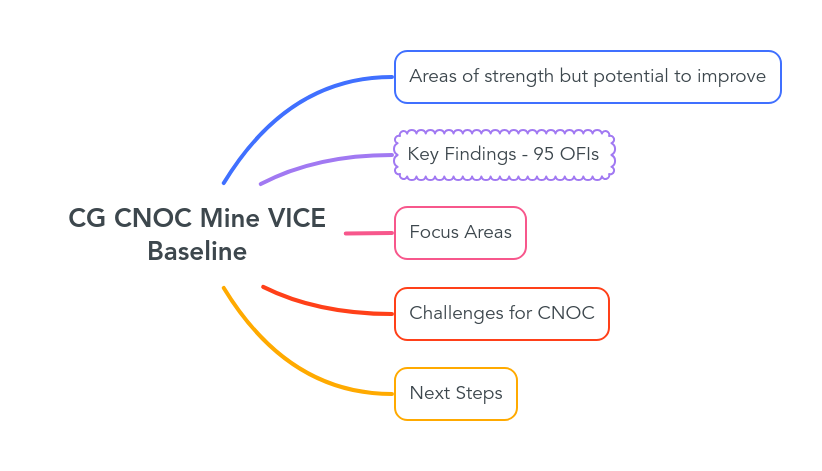
Curragh North Open Cut Mine: An Operation with strengths and opportunities for improvement
CNOC is a well-managed, productive operation with robust practices that align with industry standards. The VICE Baseline confirms that site processes are well-documented, implemented effectively, and generally reliable.
Key Findings: 95 Opportunities for Improvement (OFIs)
Despite its strong foundation, the review identified 72 OFIs, highlighting:
- Gaps Between Intent and Practice: Discrepancies between documented procedures ("work as documented") and real-world execution ("work as done").
- Commitment to Excellence: Many OFIs build on current practices, reflecting the dedication of participants to drive continuous improvement.
Focus Areas for Improvement
A structured, iterative approach is needed to address OFIs, emphasizing relevance, practicality, and value-add Key focus areas including:
- Road Design and Maintenance: Review intersection standards and haul road construction/maintenance protocols.
- Communication Practices: Enhance positive communication protocols for vehicle interactions.
- Operational Consistency: Address equipment selection, planning, and system design gaps.
Challenges at CNOC
Harmonising the approach is a key challenge for a site with multiple business partners who need to integrate their activities and standards of work.
Next Steps
Senior management should appoint review teams to review the opportunities for improvement summarised in Section 2 of this report with full details available on the Coronado Global CNOC Mine Knowledge and Performance Platform.
The 5 Pillars of Safe and Productive Operation
Mouse over pulsing icons for more information…
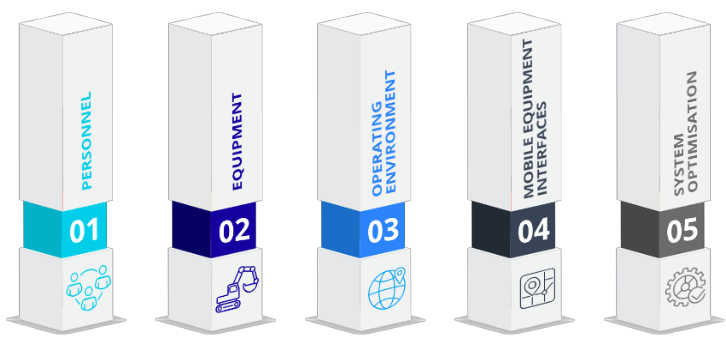
Operators and all people working around mobile equipment are trained, competent, authorised, informed, alert, and situationally aware.
These business inputs focus on ensuring:
- Operators of mobile equipment are well-trained, competent, authorized, and stay aware of their surroundings.
- Workers regularly near mobile equipment are trained, competent, authorized, informed, and alert.
- Visitors to areas with mobile equipment are properly supervised, authorized, and remain alert and aware of their surroundings.
- Supervisors clearly communicate mobile equipment tasks and safety requirements to workers.
- Mobile equipment operations are regularly checked to stay safe and productive, with potential risks (like fatigue or loss of focus) identified and managed.
Equipment Pillar: Mobile Equipment is fit for use, key systems are functioning.
These business inputs focus on ensuring:
- Mobile equipment is fit-for-purpose and ready for safe use.
- Equipment is maintained to stay safe and productive during operations.
- Supporting systems, like radio communications, are suitable and remain in good working order.
- Equipment failures are reported quickly and managed effectively to reduce risks and downtime.
Operating Environment for mobile equipment is satisfactory; hazards are identified and managed.
These business inputs focus on:
- Setting standards and rules for designing and building safe operating environments for mobile equipment.
- Maintaining the work environment, including:
- Gradients, road surfaces, drainage, lighting, signage, barriers, and segregation of people and vehicles.
- Establishing processes to manage changes in operating conditions, like weather or unexpected hazards.
Mobile Equipment interfaces with pedestrians and other vehicles are well managed.
These business inputs focus on managing interactions involving mobile equipment, including:
- Pedestrian safety around mobile equipment.
- Vehicle-to-vehicle interactions to prevent accidents.
- Road design features like parking and restricted (quarantine) areas to improve safety.
- Clear standards and rules for safe and efficient operations between workgroups in all situations.
- Protocols for maintenance and service tasks in operational areas, including refueling.
System Level Optimisation Pillar: Coordinated and Integrated Vehicle Interaction Management
This group of business inputs ensures mobile equipment operations are safe, productive, and fully integrated into everyday business and operational processes. It focuses on having a system-wide view of activities and making adjustments when needed.
These business inputs help sites by ensuring:
- Operators of mobile equipment are trained, competent, authorized, informed, alert, and aware of their surroundings.
- Workers near mobile equipment are trained, competent, authorized, alert, and situationally aware.
- Work environments are designed to minimize errors as much as possible.
- Mobile equipment interactions are reviewed regularly during production planning and scheduling.
- Equipment operations are monitored and adjusted to stay safe and productive.
Summary of the key Opportunities for Improvement
The following sections present a summary of the opportunities for improvement – organised by the key pillars of safe production. Note that the sections are presented in the suggested priority order by which they should be addressed.
Pillar 1 - Personnel

- Selection, Onboarding, Inductions and Training
- Identify key training modules requiring trainer-led delivery instead of online completion.
- Standardize critical skills (e.g., 50m clearance, blind spot zones) across all CMWs and contracting groups.
- Use explicit instruction—avoid assumptions of “common sense” knowledge.
- Implement post-training assessments to confirm competency in field conditions.
- Improve Communication of Instructions and Briefings
- Improve pre-shift briefing infrastructure—start with voice amplification where needed.
- Implement structured feedback loops to confirm understanding of SOP changes and toolbox talks.
- Provide clear, timely follow-ups on CMW-reported hazards and investigation outcomes.
- Fitness for Work
- Trial early-warning fatigue detection technology (e.g., biometrics, in-vehicle monitoring).
- Review shift rosters and cumulative working hours for fatigue risk trends.
- Leadership and Performance Management
- Strengthen supervisor selection and training to ensure technical and leadership competency.
- Reinforce “Safe Production” principles—prevent production pressures from compromising safety.
- Implement structured leadership feedback and monitoring processes.
- Additional Considerations
- If possible, integrate a digital tracking system to log and monitor key initiatives, ensuring visibility on training completions, communication effectiveness, and leadership performance.
- Implement a digital workflow system to allow CMWs and Supervisors to provide information on conditions encountered and decisions made in-field.
Pillar 5 - System Optimisation

- Leadership Intent and Accountability
- Review, update, and more consistently apply the Curragh North Open Cut Mine Traffic Management Plan.
- Leverage the VICE workshop outcomes to reinforce Leadership commitment to a strong safety culture at CNOC.
- Engagement and Consultation
- Implement more cross-company (CG Business Partners) structured communication to help make everyone’s approach and activities consistent and to a high standard.
- Improve change management consultation and communication e.g. on Traffic Management plan requirements, and selection of new equipment for use on site.
- Supporting Systems
- Review the effectiveness of change management processes for new equipment.
- Review incident management and hazard reporting processes – communicating learnings.
- Review and align mining operations inspections and task observation processes.
- Governance and Assurance
- Confirm that experienced senior managers have oversight of site Traffic Management Plans
- Improvement Planning and Leveraging Technology
- Confirm and Communicate intentions around improving technology that supports better operator decision making in-field.
- Apply VICE review outcomes to leverage outcomes from deployed and up-coming technology projects to generate the optimum improvements in mine designs and production planning.
Pillar 2 - Equipment
- Human Systems Integration
- Confirm ergonomic layout of operator displays aligns with site standards.
- Standardize placement and function of communication tools (radio handsets, etc.).
- Improve in-cabin access to OEM manuals and safety information.
- Equipment Selection and Site Use Approval
- Strengthen site processes for equipment selection and approval.
- Standardize technology installations, equipment identification, and lighting requirements.
- Increase CMW involvement in equipment selection to prevent operational inefficiencies.
- Enhance site auditing to prevent non-compliant equipment from remaining in service.
- Maintenance
- Improve maintenance backlog management by incorporating in-field inspections before scheduled maintenance.
- Standardize maintenance processes across all contractor groups to ensure consistency.
- Operator Checks and Defect Management
- Review prestart checklists and defect classifications, including non-OEM technologies and operator comfort systems (e.g., air-conditioning, seats).
- Confirm clear response protocols for alerts and alarms to standardize operator actions.
- Other Equipment Opportunities
- Establish a unified approach to position and speed alerting to prevent conflicting signals.
- Optimise use of mobile equipment performance data for better operational decision-making.
Pillar 3 - Operating Environment

- Road and Intersection Design, Construction, and Maintenance
- Ensure consistent application of site standards for haul roads, ramps, and intersections from design through to maintenance.
- Address resource constraints that cause delays in pavement repairs, delineation, and sight-line improvements.
- Parking & Pedestrian Safety
- Improve parking area layouts and reduce congestion at go-lines.
- Introduce better defined pedestrian walkways to separate foot traffic from vehicle movement.
- Management of Operating Environment Hazards
- Assess lighting adequacy in-pit and at key infrastructure points, implementing improvements as needed.
- Strengthen management of visibility hazards (dust, weather conditions) through improved controls.
- Increase powder factors to reduce muck size and improve in-pit materials handling (excavators and dozers)
- Changes in Conditions
- Standardize trigger action response plans (TARPs) across business partners to ensure a coordinated response to changing conditions.
- Improve communication and enforcement of speed limits and road condition updates to keep all crews informed.
- Accountability & Oversight
- Clearly define in-field responsibilities for maintaining roadwork and operational area conditions.
- Improve monitoring and enforcement of compliance with road and traffic management rules.
Pillar 4 - Work Group Interfaces
- Planning, Schedule and Shift-to-Shift Briefings
- Improve short-term planning to reduce congestion between business partners and functions.
- Standardize shift handover processes to improve situational awareness.
- Operational Practices
- Review breakdown, maintenance, and servicing protocols for better clearance and area delineation.
- Standardize escort and towing processes, ensuring trained personnel.
- Reinforce minimum standards for positive communications (radio use, pedestrian safety, and performance monitoring).
- Assess light vehicle access—limit authorized drivers and vehicle numbers where practical.
- Optimize refueling processes—location, communication, and interaction with HME operations.
- Access Control and Exclusion Zones
- Improve pedestrian management in operational areas and workshops.
- Review exclusion zone protocols to ensure consistency across workgroups.
- Vehicle Interaction Monitoring
- Develop use cases for CAS and camera technology to differentiate between detected objects (e.g., pedestrians, LV, ancillary equipment) and improve vehicle operator decision making.
- Other Workgroup Interaction Opportunities
- Align technology projects with workshop findings to enhance vehicle interaction controls.