
Mining and resources
Building a mine or running one, the work makes the record.
Risk Mentor connects what your people know about the risks, your control requirements and the everyday work, so crews and leaders decide from the same picture: Control Framework expertise, implementation support and connected field workflows.
Building a mine? Put the system in as the mine develops, so the record starts with the first shift.
Running one? Connect what you already have and improve it, without starting again.
In use at surface and underground operations, with methods applied across five continents.
572 experienced people at 39 operating sites told us where their controls fall short.
Before we build anything, we baseline. A Vehicle Interaction Control Effectiveness (VICE) baseline tells a site where it actually stands: experienced site people compare the work as documented with the work as done, control by control, against a Risk Mentor Control Framework. It is also the first step from analogue to digital. Plans, registers and findings are mapped once and held as linked data, ready for everything that follows. Every opportunity for improvement is recorded in their own words.
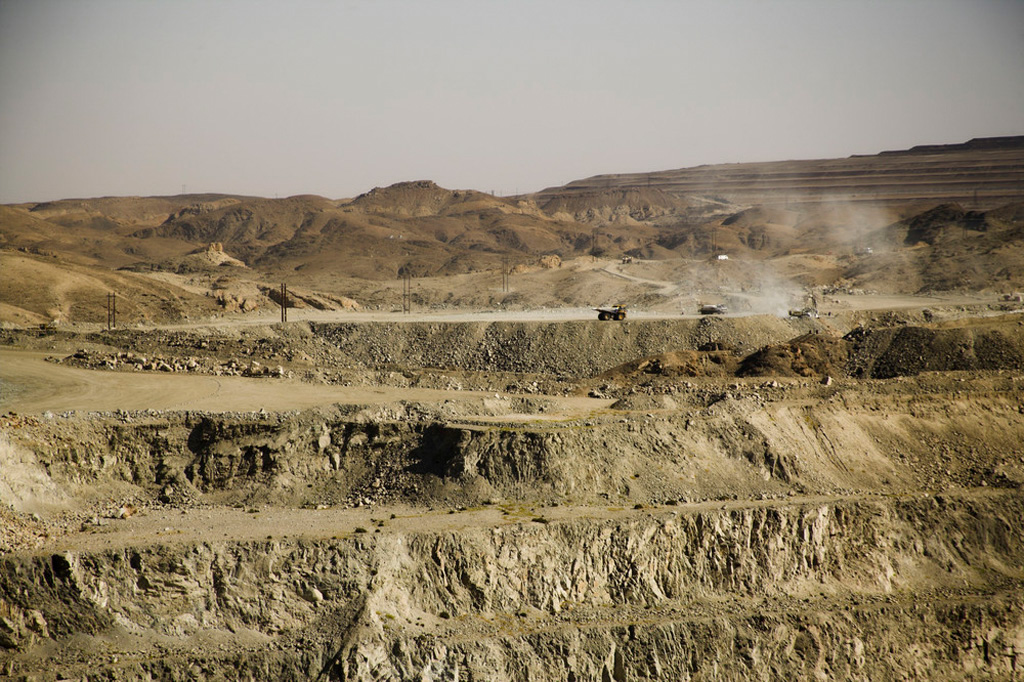
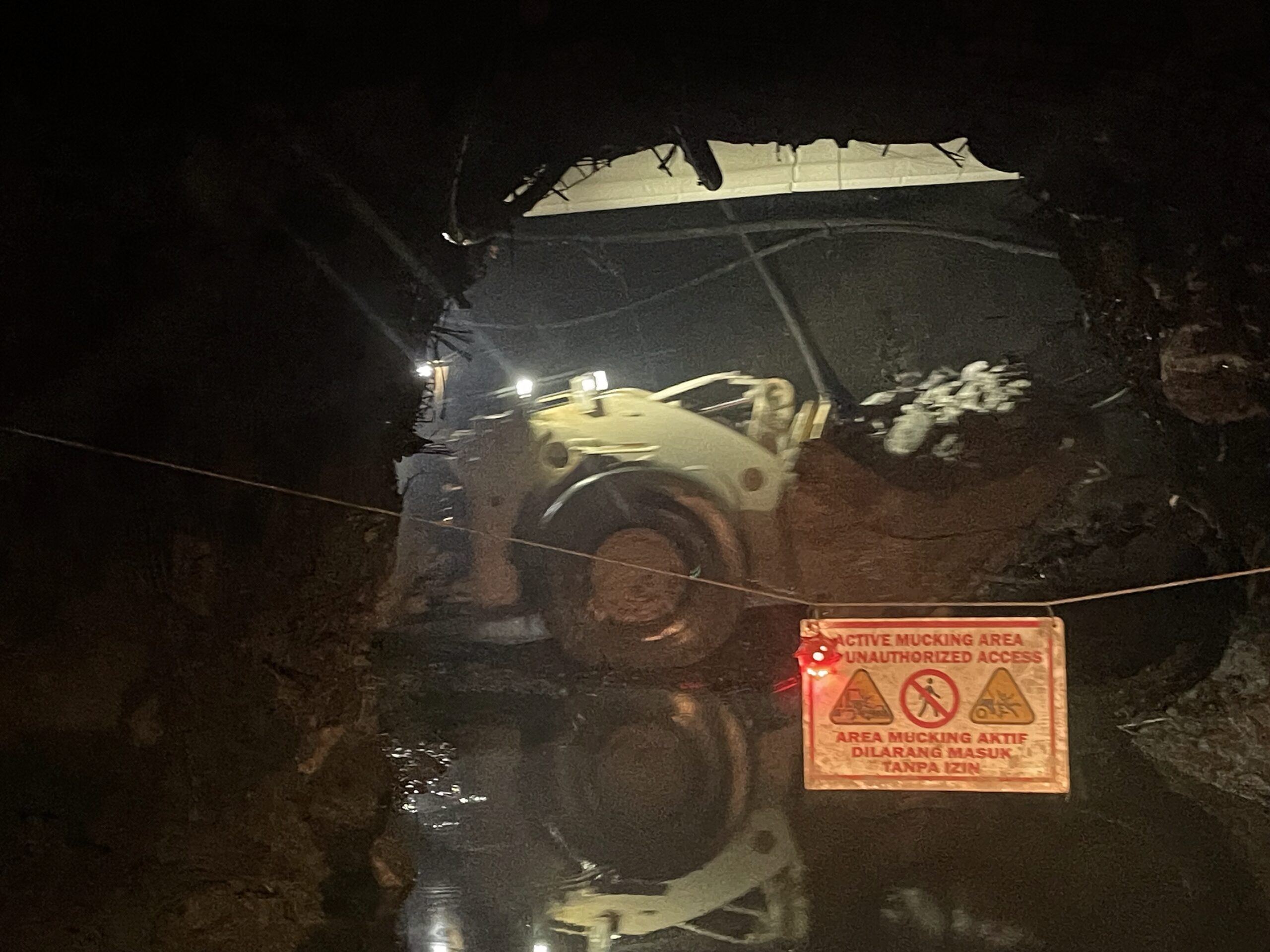
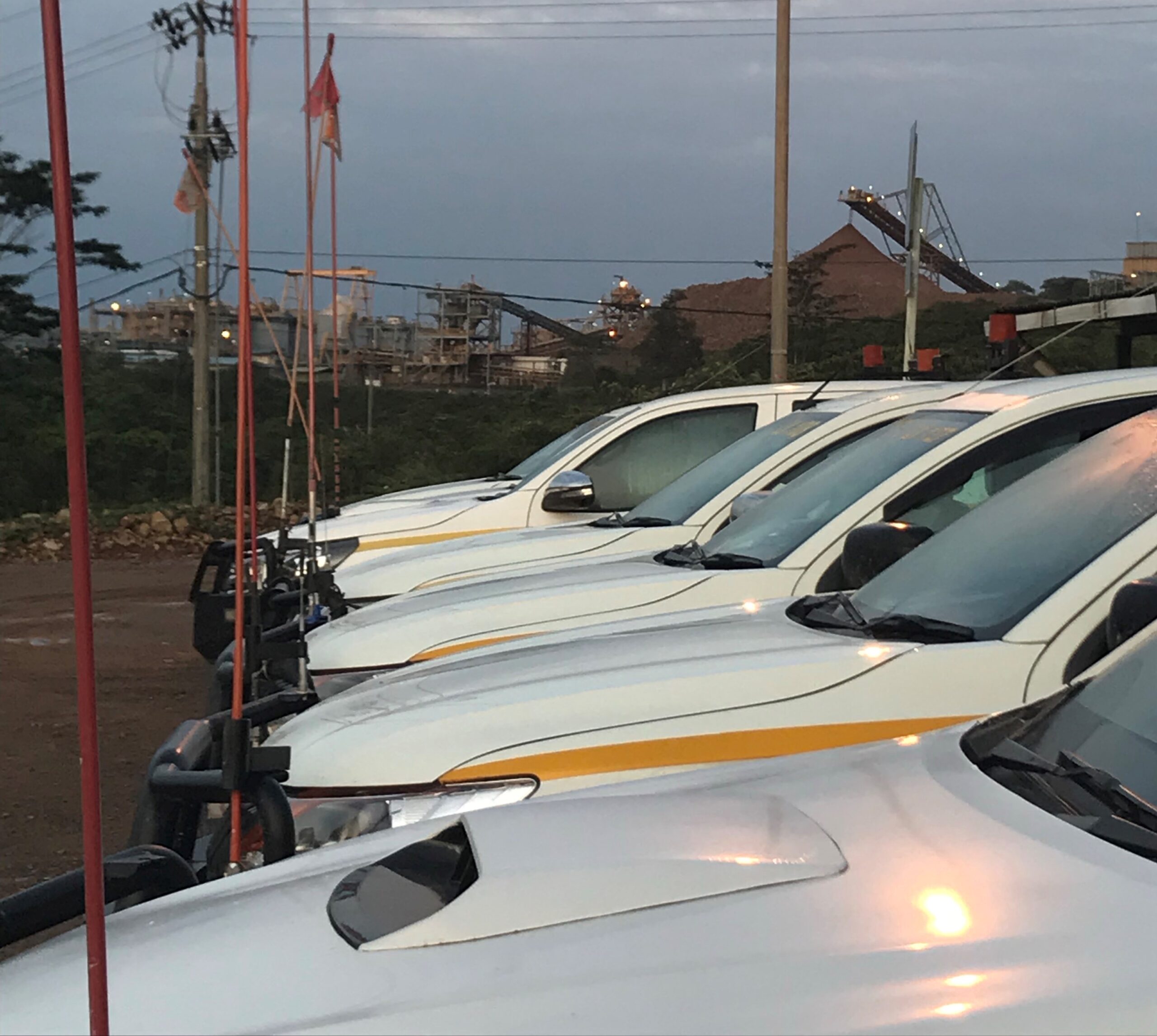
Surface, underground and on the roads between: vehicle interaction is a risk at every site.
Risk Mentor vehicle interaction baselines, March 2019 to October 2026. Surface and underground mines, smelters and refineries on four continents: iron ore, copper (including block cave), gold, platinum group metals, diamonds, bauxite, mineral sands, lead-zinc and coal.
What they find
Nearly half of what experienced site people find is a gap between work as documented and work as done. Sometimes the design is sound and cannot be consistently implemented. Sometimes the design is inadequate. And sometimes the work has been improved in the field and the documents have not caught up.
An adequately designed process that is not monitored drifts, and fails. The same happens when it is monitored and the data is not good enough. Either way, when it fails nobody can say whether the cause was inadequate design or poor implementation.
The smallest share is recovery. The triggers and actions that return operations to a safe and productive state exist, but they vary, and they are not applied consistently.
The baseline is a reality check that sets up the bridge from analogue to digital. Experienced site people compare what is documented with what is done, and the real picture of the work is what crosses. The path from there runs in phases, and the record built at the baseline carries through every one: the five phases below.
From baseline to performance intelligence. Five phases. Digital starts at the baseline and carries through every phase to production deployment.
- Design BaselineUnderstand your performance starting point. Site documents, conditions and incident history are mapped to the framework: 13 Required Operating States, about 83 Credible Failure Modes and about 110 Business Inputs for vehicle interaction. The baseline is built in the Digital System Master from day one.
- Operational EffectivenessManagers, supervisors and trades compare the work as documented with the work as done, sort the opportunities for improvement and agree the plan to return to nameplate performance. Mark-ups are digitised daily; the action register and Digital Roadmap stay live.
- Performance EnhancementChosen improvements are piloted, built into operations and deployed. Connected field workflows take them to the point of work, and the baseline is updated.
- Step Change EnhancementWhere the risk requires it: capital-intensive options such as collision prevention technology, selected against user requirements drawn from the baseline.
- Leveraging Performance IntelligenceDispatch, proximity detection, operator, asset and location data are linked to the baseline. Drift is detected early, and decisions are supported at task, supervisor and manager level.
From 2017 to 2024, Risk Mentor worked with EMESRT in support of the ICMM Innovation for Cleaner, Safer Vehicles programme, running multiple workshops and three leading site cohorts based on our operational practice. Earlier editions of our Vehicle Interaction Control Improvement Project Guide were shared through EMESRT. A new Risk Mentor edition is coming soon.
The same method has been applied to mobile equipment fires and to tyres and rims, where even well-run sites found 12 to 26 opportunities each.
Most hazard management plans are written for the regulator. Ours are written for the people doing the work, and issued from the system that runs the shift.
Every mine has its hazard management plans, whatever its regulator calls them, its risk registers and its procedures. Usually they live in separate documents and spreadsheets. The controls are in the plans; whether they were applied is assumed, and checked now and then.
Sound familiar?
- Three risk registers in Excel, one for underground, one for construction, one for the corporate level, each managed by a different person and none linked to the others.
- Task-level risk assessments that never feed back into the registers.
- An incident and actions system that sits apart from the risk and control architecture.
- Legislation, permits and consents met, but the registers hard to use, and harder to show.
That was one operation approaching production. Capable people, sound records, in fragments. The opportunity wasn’t compliance. It was usability, integration and a foundation that scales with the workforce.
Seven questions worth asking of your own operation
- Before today’s first task, which controls does the crew need in place, and where do they read that: in the plan, or in the job?
- When a bowtie names a control, is it a step in someone’s work today, or a line in a document?
- When a control is weakened, compromised or simply not applied, do you get a signal that shift, or do you find out later, through the archaeology of an incident investigation?
- Does the person doing the task confirm the control at the step it belongs to, or does someone assume it afterwards?
- Does your risk picture change as the site changes: shutdowns, development, weather, a new contractor?
- When an experienced operator or the person who built the registers leaves, does what they knew stay in how the work is done?
- How many times do you call on the same control across your registers and plans, described five different ways, and how would you know if it was never done?
The seventh is where the waste hides. The same control, written five ways in five registers, is five chances to miss the one time it wasn’t applied.
The usual way
- Risk registers kept in separate spreadsheets, not linked to each other
- Plans written, approved and filed
- Controls assumed in place, checked at audit
With one record
- One linked set: every hazard, control and obligation held once, as an agreed point of truth. Your records stay in your systems; we link them
- Plans issued from the live system as controlled, point-in-time snapshots
- Controls confirmed at the task, shift by shift, and reported from the same records
- Every plan has the same front end, learned once. The work lives in the appendices, which stay current with the record
- Every control in the plan names the role accountable for it, so the people named can open the plan and see what they hold
Five things a regulator will ask you to show, and where the record answers
- The plans are well designed.Each control is linked to the failure it stops and the obligation it meets, so the design can be read and challenged.
- People understand how to apply the controls.The controls sit in the workflow, at the step they belong to, in the crew’s own words.
- The plans are implemented.Each completed task returns a record of what was checked, by whom and when.
- Their use is routinely verified.Supervisors, managers and the board read the same records, so verification happens every shift, not once a year.
- They are reviewed and kept current.The plan as issued and the work as done sit side by side. Where they differ, the plan is revised in one place and reissued.
Compliance still matters: your obligations are mapped into the work, site by site. It’s the by-product of a system built to control risk and support good work, not its purpose.
A premortem, held as a live record.
The Control Framework starts with the state operations have to be in to be safe and productive, then works back to the credible ways that state is lost and what keeps it. Each layer links to the next, many to many. Obligations are mapped across the framework, not held in a separate register.
Risk is managed by location and by activity. Controls attach to where the work is and what the work is, and step up as the work moves: from the portal to the decline face, from development to stoping. Below, one thread is traced from the framework to the task and back as the record.
Digitisation, applying the Control Framework architecture
The standards go out to the field. The record comes back, from whichever system captured it. Leaders read both. The Digital System Master is the hub: your plans, standards and obligations organised once by the architecture, framed into field workflows, and read back as the operational ledger. Click the diagram to enlarge.
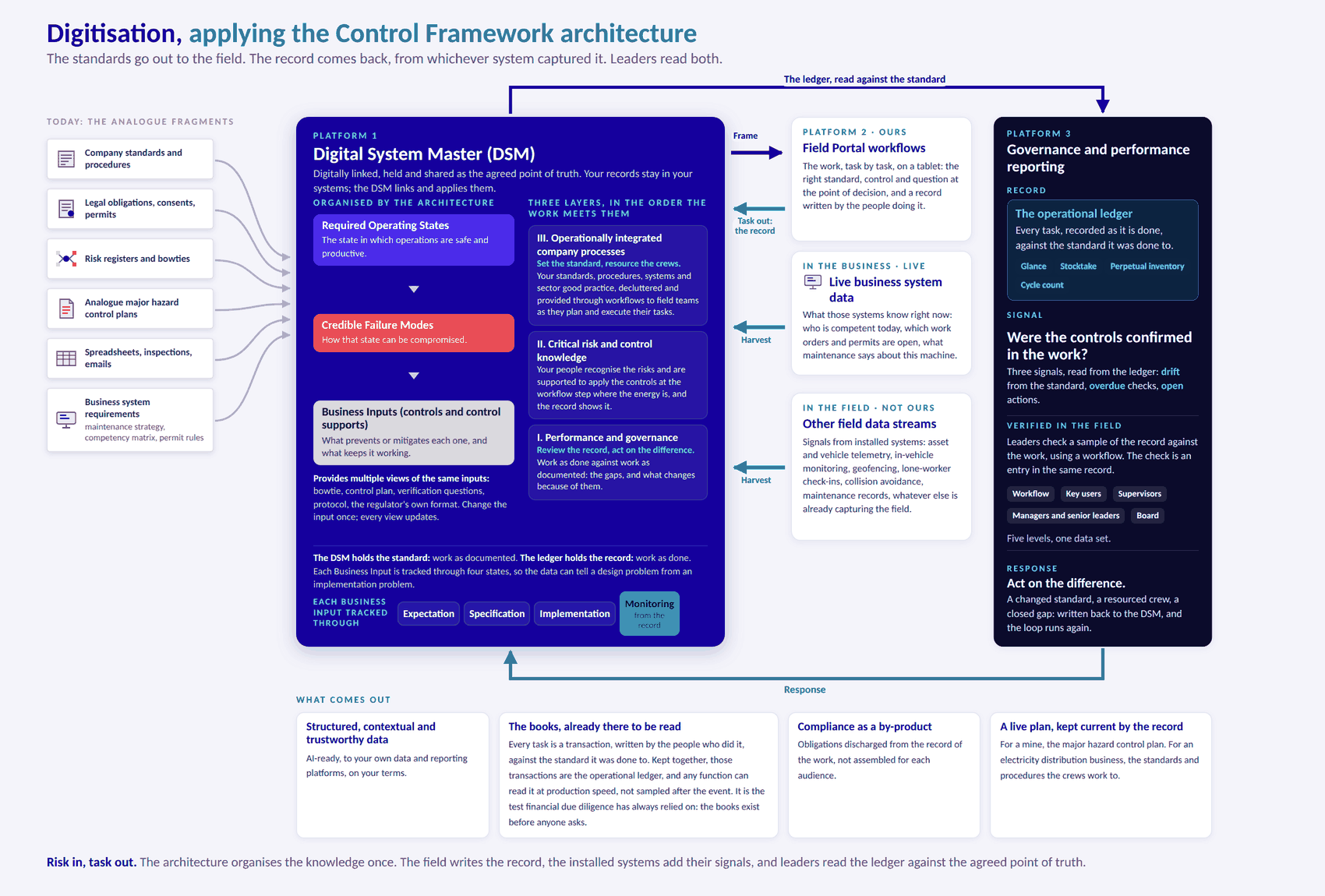
Written once, held in the Digital System Master, kept current as plans and operations change, and issued to every hazard plan, procedure and workflow from there.
Set side by side, the two records show whether the controls were confirmed in the work, and where leaders checked. The difference is what management acts on.
One Control Framework library. Any operation, any regulator.
Every regime asks for plans for the hazards that can kill. The names differ: principal hazard management plans, major hazard control plans, critical control plans, mine safety plans. The hazards, and the controls that stop them, don’t.
Each plan is built from the same Risk Mentor Control Framework and drawn as an active bowtie that holds the site’s own causes, controls and local detail. Local variation lives at the edges; the framework underneath stays the same, so sites can be compared and lessons travel.
15 Control Frameworks in the library, and growing. A site takes the ones its major hazards call for.
Traced to the regulation
BI-CPA.05.01 Maintainer Skills, Competency and Authorisation
BI-EPA.31.20 Electrical Equipment Inspection, Testing and Maintenance
BI-CPA.03.01 Trained, Competent and Authorised Operators
BI-CPA.05.01 Maintainer Skills, Competency and Authorisation
One clause can call on several Business Inputs. One Business Input can meet several regulators. The mapping is kept once, and every plan is issued from it.
Our frameworks, and who may use them
The vehicle interaction, mobile equipment fire, and tyre and rim Control Frameworks, the baseline method and the project guide were created by Risk Mentor. They are owned by RMDE Australia Holdings Pty Ltd and published under licence by Risk Mentor Pty Ltd. The vehicle interaction framework is in its fifth version.
Operating sites may apply them at site level under licence. The licence doesn’t extend to combining results across sites, or to consultants working beyond a single site. Consultants and service providers who want to work with the frameworks: talk to us.
Engineered controls already have their books
The outlier is human and procedural controls. The platform gives them the same discipline the engineers already apply: a record, made at the task, judged against the standard. Safety borrows a proven practice from operations. It isn’t a new safety idea.
Start with what you have. We map your register, your plans and the regulator’s guidance to one framework, and show where they agree and where they don’t.
Thirty years of experience at the point of decision.
The people closest to the work know it best. Field workflows are built with the crews, in the order the work happens, with each control placed at the step it belongs to. They work offline underground and sync when the device is back in range. The workflows start from the forms the crews already use. When a crew member syncs a job, a copy of what they recorded comes back to them: the first reader of the record is the person who wrote it.
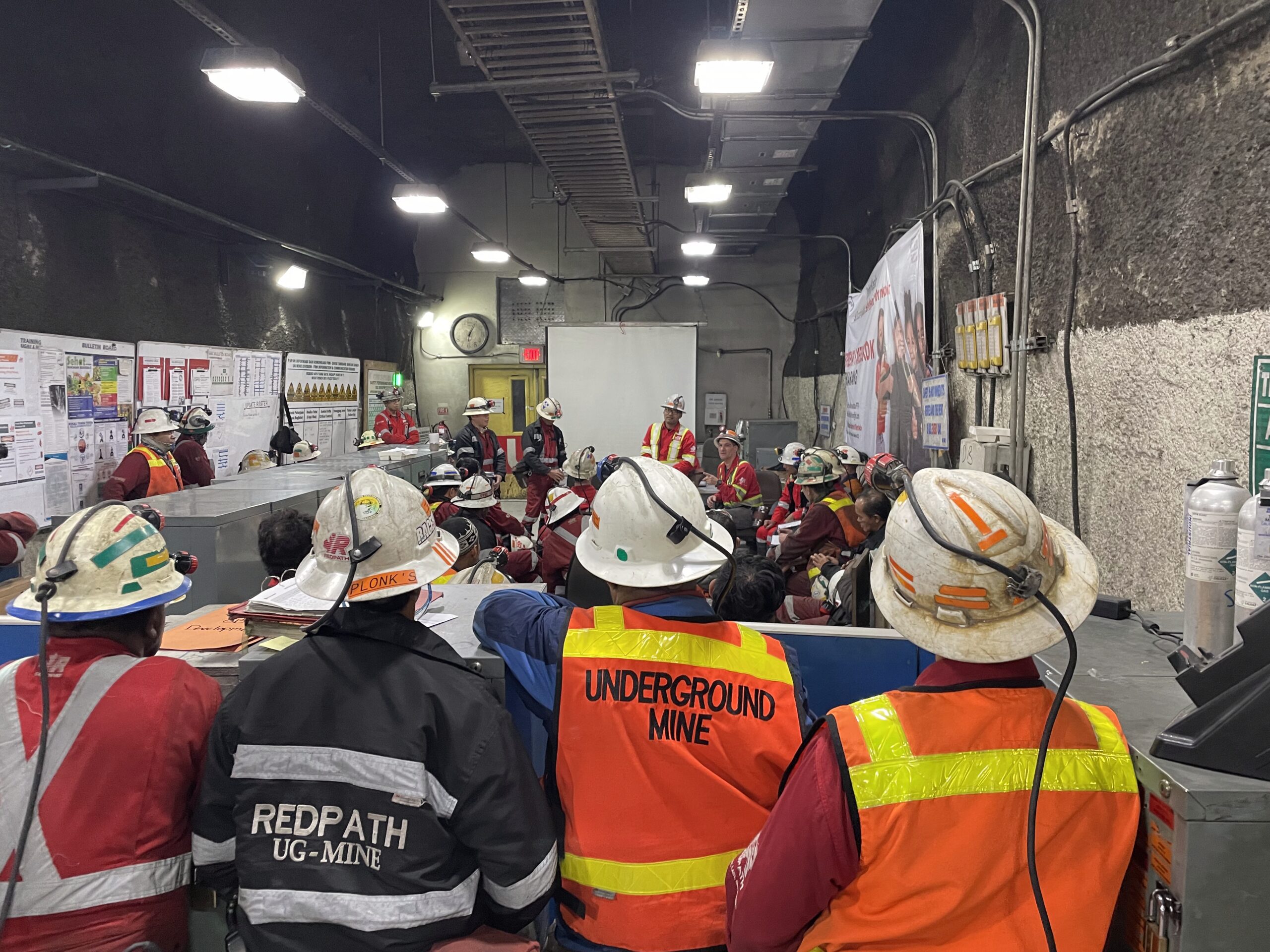
Crews help design the workflow, which is what drives use. The same steps that guide the job are the record that it was done.
Five levels, one record, nobody re-telling it.
The crew, the key users, supervisors, managers and the board read the same primary records, each at the level they need. Performance and verification status come from the records the work created, not from a summary written about them.
Where a control is named as critical, the record shows each time it was confirmed at the task, and what happened when it wasn’t. Leaders test a sample in the field, and the test is an entry in the same record.
A pre-use vehicle check is a safety record and a maintenance request at once. One entry, read by whoever needs it.
Who keeps the record
Operations owns the record, because operations owns the systems that generate it. The safety function helps design the frame, reads the record with operations, sets the sampling and tells the board whether it can be believed. That is a promotion, not a demotion.
Two questions for any assurance you run
Incident data fails the second. Observation fails the first for every task it didn’t see. A record of the work passes both: the missing entry is the signal.
Active bowties
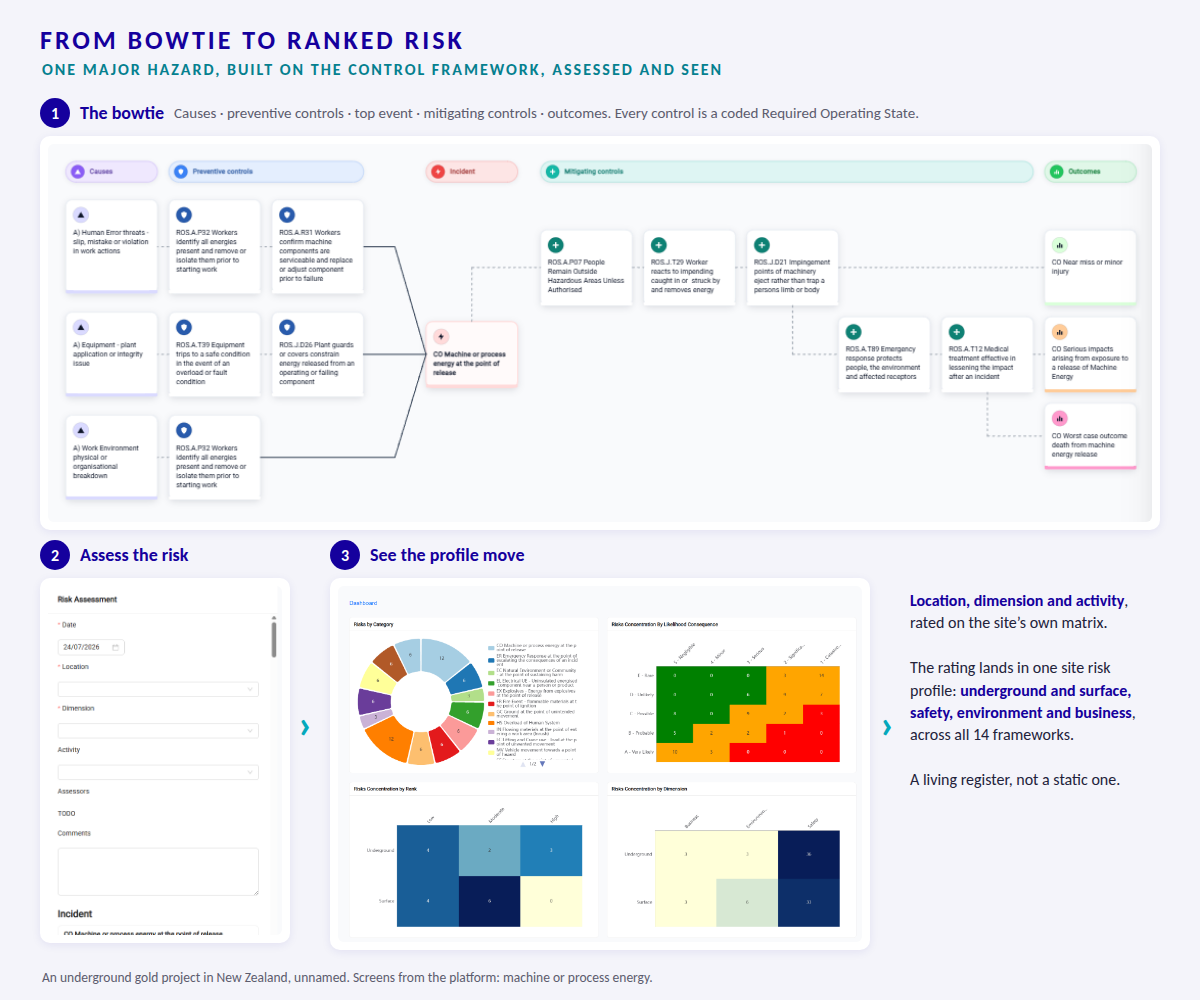
Each major hazard is drawn as a bowtie built on the framework. Its controls are linked to the records the work returns, so the bowtie shows which controls are being confirmed at the task and which have gone quiet, and the hazards can be ranked on what the record shows, not on opinion.
Start where your leaders need to start
One operation asked for the risk profile first and verification second. For their stage, that was the right order. The architecture doesn’t care which door you enter by.
The same platform at a New Zealand electricity distribution business manages about 1,500 mapped obligations and returned 19,229 field records in FY26. See the electricity distribution page →
The expectation on leaders has grown. The record hasn’t.
Production can tell you every tonne and where it went. Maintenance can tell you every hour on every machine. Can you say, from a record, whether the controls were confirmed on today’s jobs?
Wherever you operate, leaders and managers are expected to know what is happening on the ground, not just what was planned. After a serious incident the question is the same everywhere: what did you know, and how did you know it? The answer has to be a record of the work as it was done.
Example: Australia and New Zealand
- 2011Model WHS lawOfficer due diligence becomes a positive, continuing duty, including to verify
- 2015New ZealandThe same duty arrives in the Health and Safety at Work Act, in force from April 2016
- 2017QueenslandIndustrial manslaughter enacted, the first state to do so
- 2018Queensland miningOfficer due diligence written into the coal and metalliferous mining Acts
- 2020Queensland mining · Victoria · NTIndustrial manslaughter in the Queensland mining Acts; Victoria and the Northern Territory follow
- 2022Western AustraliaMines brought under one WHS Act, with industrial manslaughter
- 2024Queensland mining · SA · NSWCritical controls written into the Queensland mining officer duty; South Australia and NSW commence industrial manslaughter, NSW with no limitation period
- 2026New ZealandA chief executive’s personal conviction under the officer duty upheld. An amendment, passed in July 2026, narrows the duty to understand, ensure, verify, in force from 1 April 2027
The duty got heavier at every step. At no step did anyone say what the record should be.
The argument in full: Boyle, M. (2026). Due diligence – health and safety: a performance review, and what next? New Zealand Journal of Health and Safety Practice, 3(3). Peer reviewed. doi.org/10.26686/nzjhsp.v3i3.11257
In operation: built from the start, or brought together mid-stream.
A new mine building its way of working from the start. The safety management system, the major hazard control plans and the procedures are all issued from one live system.
- 16 elements in 8 groups, each with an intent and the expectations that show how the mine operates
- Every expectation, control and responsibility held once, as a linked record
- Plans and procedures issued as controlled snapshots, with a printed set kept current for the crib room and the regulator
- Built around four questions every worker should be able to answer about their own job
An operation with experienced people and risk assessments built from real operational experience, held in separate spreadsheets. The first phase brought them together and built the frameworks.
- 14 Control Frameworks built, one per major hazard
- 15 risk assessments, including 4 site registers, consolidated into 616 controlled entries
- 329 legal requirements, from the Act and the mining regulations, mapped to Business Inputs
- Proof of concept: the 41-page inundation and inrush plan rebuilt on the framework, every active requirement traced to a Business Input
- Next: existing plans converted to digital, then field workflows with production teams
Three stages, one architecture
Different starting points, the same end: one record that the plans, the crews and the board all read.
Snowy River Mine: building resilient operations through digital system integration.
A case study presented at the AusIMM International Mine Health and Safety Conference, IMHS2026, Perth, 5–7 October 2026, by Kylie Harris, Health, Safety, Environment and Community Manager, Endura Mining. Authors: P D Enright, K Harris and M J Boyle. Mike Boyle is a co-author and chief executive of Risk Mentor; the case study says so up front.
Snowy River Mine, operated by Endura Mining near Reefton on the West Coast of New Zealand’s South Island, is moving from construction into production. First gold is planned for December 2026, the workforce is growing to about 250 and includes people new to underground mining, and the mining contractor mobilised on 1 October 2026.
The commitment
Resilience built into how work is planned and done. Two questions drive it: what do our frontline crews need to make good decisions, every time? And how do we spot and correct drift before something goes wrong?
The gap was never intent. It was systems architecture.
Good people, a genuine commitment to safety, and risk registers built from real operational experience. What the system could not do was tell anyone whether safe and productive outcomes were happening by design or by chance.
What was built: the risk and control foundation, completed mid-2026
Built on AS/NZS ISO 31000:2018. It complements conventional risk assessment; it doesn’t replace it. One plan, the 41-page inundation and inrush Principal Hazard Management Plan, was rebuilt on the framework as a proof of concept, with every active requirement traced to a Business Input.
One source, every report
Annual work plans, WorkSafe NZ, the permit and consent authorities: each report drawn from the same controlled source, as required, rather than reassembled for each audience. Audit and assurance preparation runs at production speed, in days rather than weeks, because the data is already linked to the requirement.
A deliberate call: risk picture first, field workflows next
Where it stands, October 2026
Three insights
- Fragmentation can be tamed. Map the full inventory, archive what has served its purpose, and connect the rest to how the mine runs.
- The window won’t reopen. Construction to production sets the standard for the next decade. Start new crews in integrated systems; don’t retrofit.
- The data asset should compound. Once field workflows are live, every cycle of work should improve the data, and the decisions. An expectation, not yet a result.
Do safe and productive outcomes happen by design, or by chance, and how would you know?
Case study presented with Endura Mining’s agreement. Figures as at the presentation, October 2026.
Questions we’re asked
We’re still in development. Isn’t this a production problem?
It’s easier now. A new mine can build its plans, procedures and workflows from one record at the start, rather than untangling separate documents later.
Will it work underground without signal?
Yes. Workflows run fully offline and sync when the device is back in range.
Does it replace our hazard plans?
No. Your principal hazard management plans or major mining hazard control plans are issued from it, as controlled snapshots. A printed controlled set stays current for the crib room and the regulator.
We already have bowties. Why do we need you?
Your bowtie becomes one view of a live system, with the work’s signal on each Business Input. We operationalise bowtie thinking; we don’t replace it.
We already do critical control verification.
A good start, and one layer. It gives no signal when the context changes, and a digital record doesn’t have to ration attention to a short list.
We already have risk registers. Do we start again?
No. We bring your existing registers together, link them to the framework as an agreed point of truth, and keep what your people already know. Your records stay where they are; what changes is that they connect.
How do contractors fit in?
Contractors work to the same workflows and write to the same record, so the operator sees their controls the same way it sees its own.
Does it replace our business systems?
No. Maintenance, HR, training and contractor systems stay. We connect to them, so the information reaches the crew at the task and the record comes back to where it’s useful.
Which jurisdictions does it cover?
Any. The framework library is mapped to the obligations that apply to your site, whatever your regulator calls them, including the clauses that don’t apply, and why.
Our terms are different from yours. Does that matter?
No. Required Operating States, Credible Failure Modes and Business Inputs sit underneath. Your plans, bowties and procedures keep your names. If you call them critical controls, performance standards or control plans, that’s what your crews see. Paper systems had to ration attention to a short list of critical controls. A digital record doesn’t have to choose.
Can our consultants use your frameworks?
Service providers working at one of your sites, for that site, can apply them under your site’s licence. For any wider use, including work across several sites or in a consulting practice, contact us: we work with support consultants under agreement. The frameworks are owned by RMDE Australia Holdings Pty Ltd and published under licence by Risk Mentor Pty Ltd.
Who owns the data?
You do. Your plans, registers and the records your people create belong to your operation, and can be exported at any time.
Can every worker answer the four questions?
What could seriously harm me? What controls stop it? What’s my part? What do I do if they aren’t working? We’ll help you find out, and show you how the answers become the record. Start with what you already hold.
Ask about a baselineWho keeps your record of control performance?
A first conversation costs nothing. We’ll show you the record working at an operation like yours.
Talk to Risk Mentor