
The work makes the record.
Risk Mentor connects your people’s knowledge of the risks, your control requirements and the everyday work: Control Framework expertise, implementation support and connected field workflows, for high-hazard operations. Proven in mining and electricity distribution.
- Clear requirements at the point of work
- Gaps and drift seen early
- Traceable data for operational and governance decisions
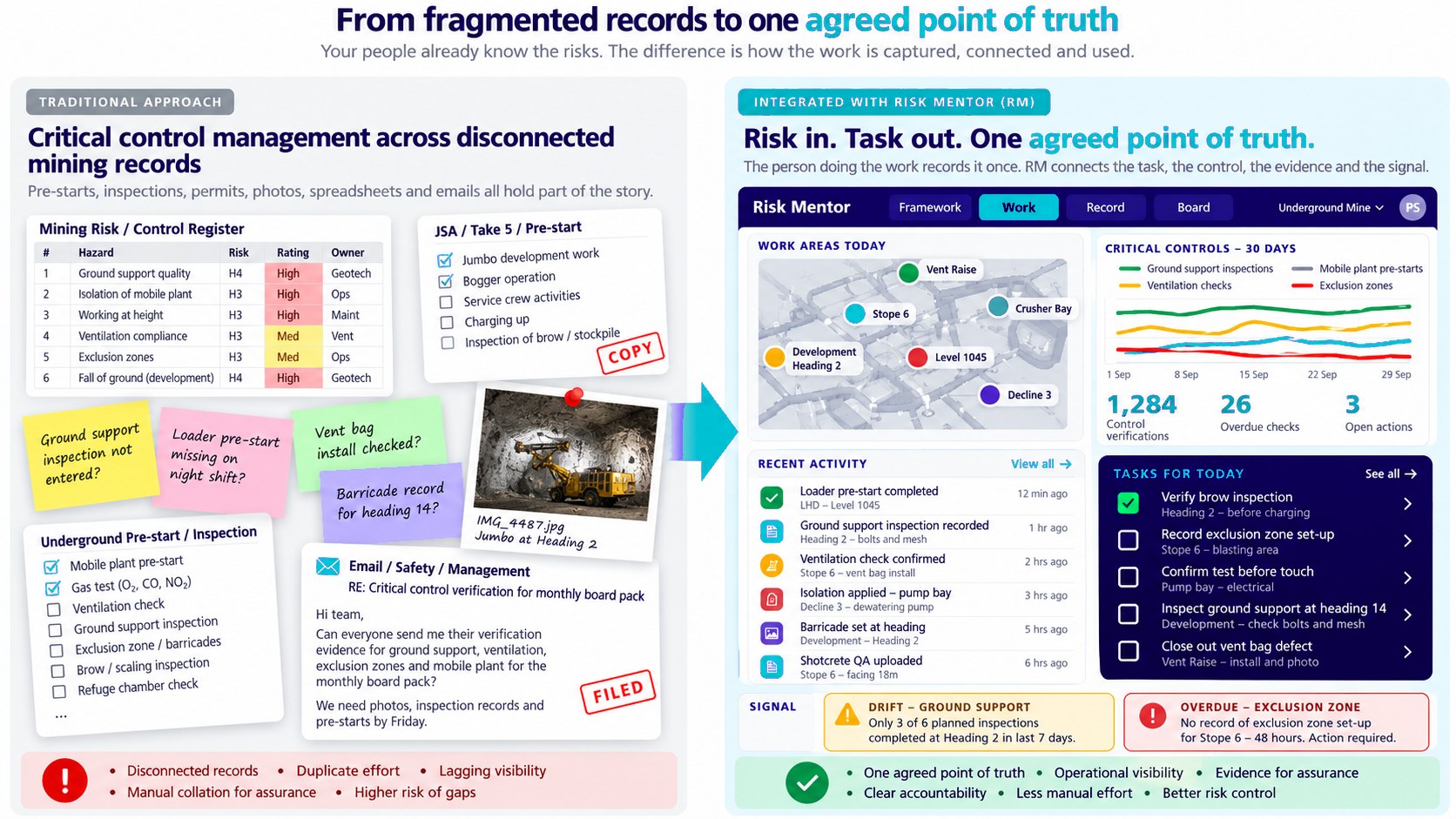
From fragmented records to one agreed point of truth: fewer forms, shorter tasks, one place to look. Your records stay in your systems; the Digital System Master links them. Click to enlarge.
What changes
For the people who do the work
- The task, decluttered. The right standard, control and question at the step where the energy is, not a forty-page procedure.
- A record they write once, as part of the job. When they sync, a copy comes back to them: the first reader is the person who wrote it.
- Experience kept in the system when the person who held it leaves.
- Agency with guardrails: authority to act within visible boundaries.
For the people who sign for it
- The record that runs the work also shows how the duty is being met.
- Drift seen early, as a signal someone can act on, not found later in an investigation.
- A sample of the record checked in the field by leaders, with the check written in the same record.
- Audit and assurance at production speed, from data already linked to the requirement.
Not a safety system beside the work. The work, recorded as it is done, read by everyone who has to decide.
What each reader gets
The person at the energy
The supervisor
The manager
The officer
Proven in use: PowerNet, FY26
PowerNet, FY26
Figures used with permission.
About 1 in 50 field records is checked in the field by someone other than its author.
A sample can test a ledger. It cannot be one.
Each one checks a field record against the work it describes, and is itself an entry in the same record.
Who verified, FY26
- Supervisors219
- Managers72
- Senior leaders40
- Peers38
- Directors19
The crew writes the record; leaders test it. Every count traces back to the field records behind it.
With PowerNet, a New Zealand electricity distribution business: field workflows co-developed with frontline crews from late 2021, and operationally integrated systems in full deployment since 2023. These figures show use and coverage: field records show crews have adopted the workflows, verifications show leaders taking part at every level. In mining, the method is applied at an underground gold project in New Zealand approaching first production and at an underground gold mine in Victoria during decline development, with vehicle interaction baseline work at surface and underground operations internationally.
The paper. Due diligence – health and safety: a performance review, and what next? New Zealand Journal of Health and Safety Practice, 3(3), October 2026. Peer reviewed. Read the paper · The argument in full
How it works: risk in, task out, one record
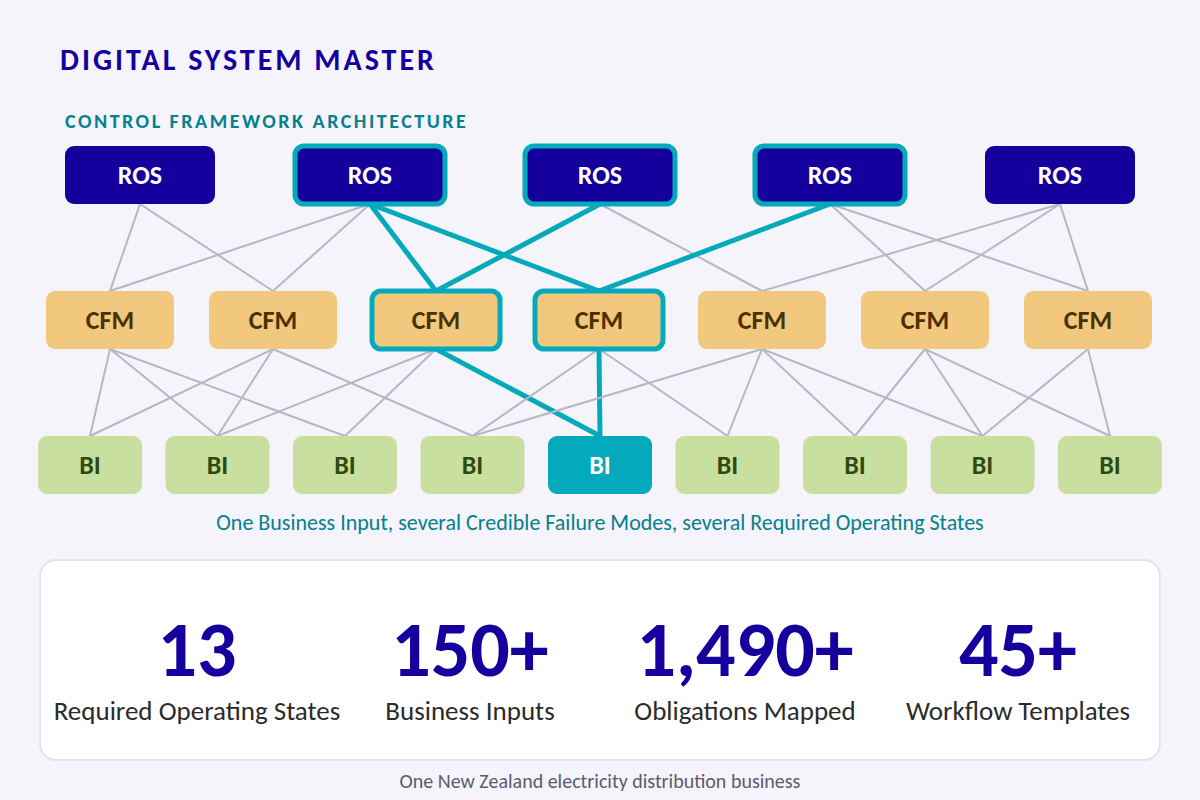
Digital System Master
Every expectation, control, responsibility and deliverable, held as one live record. It answers the officer’s questions in order: what has to be in place for the work to go right (Required Operating States), how that can be compromised (Credible Failure Modes), and what prevents or mitigates it (Business Inputs), each linked to the obligations it meets. It reconciles to your business systems, and plans and procedures are issued from it as controlled, point-in-time snapshots. The frame is written first; the work is booked against it.
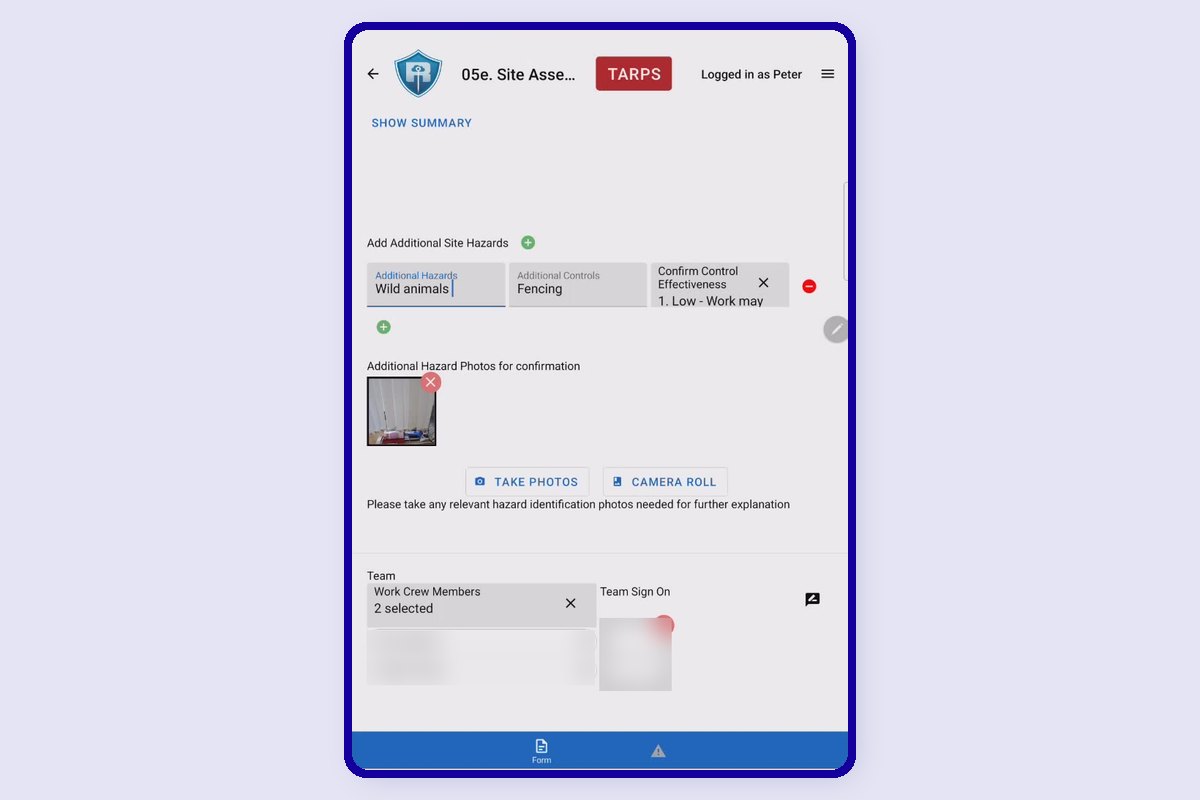
Field Portal
TASK OUTResources the crew to meet it, and brings the record back
Puts the right task workflow in front of your people and your contractors, shift by shift, on site and offline. The entry is made at the work, by the person doing it, and the first reader is its author. Nobody fills in a safety form. The work leaves a record of itself.
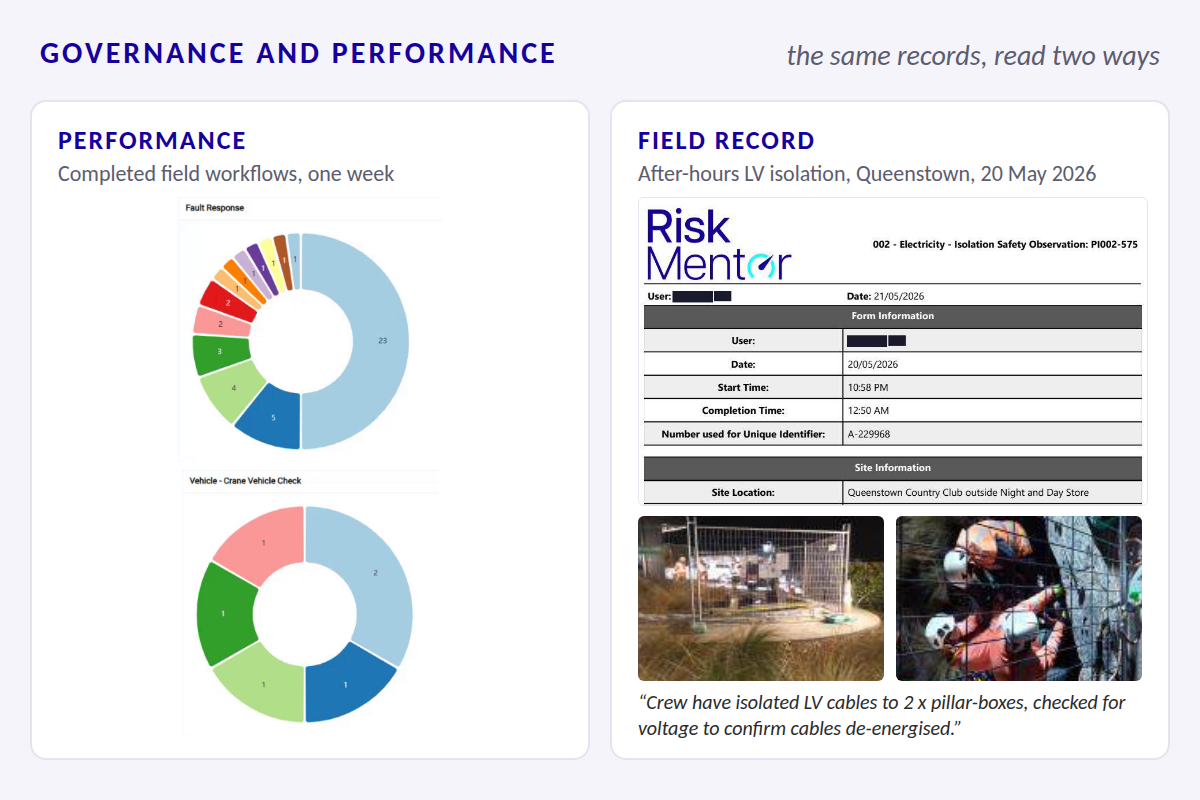
Governance and Performance
How we start
1. Foundation
2. Configure
3. Into the field
Mining and resources
NZ electricity distribution
Other high-hazard operations
Who keeps your record of control performance, and what does it cover?
Due diligence is being able to show, across time, that you did. A first conversation costs nothing. We’ll show you the record working at an operation like yours.