
NZ electricity distribution
Keep your people safe. Know what’s really happening across the network.
Your crews know the work. Risk Mentor brings Control Framework expertise, implementation support and connected field workflows, so the controls are confirmed at the job, gaps show early, and the crew and the board read the same record.
Working with PowerNet since 2016. Field workflows built with its line crews from late 2021, in full operation since 2023.
Built around the way electricity distribution businesses actually work.
Electrification is growing the network and the work programme. The people who carried the know-how are retiring, and new crews arrive faster than they can be mentored. The crews that carry the know-how are writing it into the workflows before they leave, so it stays. Through all of it, an officer still has to show that the controls were in place on the day.
Your people know the risks. The framework holds that knowledge once, linked to your standards and the law. The work confirms it, task by task. The record shows whether it held.
Each one makes it harder to know what happened at the pole. Each one makes the record more valuable.
Start with what you have. The record reports what it holds from the first month, and grows as you join it to the records you already keep: work orders, switching logs, fleet and competency records.
Proven in New Zealand.
PowerNet has worked with Risk Mentor since 2016. Its field workflows were built with its line crews from late 2021 and have been in full operation since 2023. These are its FY26 figures, published with its agreement.
In PowerNet’s words
Working with Risk Mentor, we have built institutional capability and competitive advantage. We are therefore thrilled to now be able to offer Risk Mentor to our industry colleagues across New Zealand.
Jason Franklin, Chief Executive, PowerNet, announcing the agreement to bring the platform to the New Zealand electricity sector, November 2024
PowerNet, FY26
Figures used with permission.
About 1 in 50 field records is checked in the field by someone other than its author.
A sample can test a ledger. It cannot be one. Read the paper →
Each one checks a field record against the work it describes, and is itself an entry in the same record.
Who verified, FY26
- Supervisors219
- Managers72
- Senior leaders40
- Peers38
- Directors19
The crew writes the record; leaders test it. Every count traces back to the field records behind it.
Behind the figures
Recognised with the 2022 EEA Workplace Safety Award and the 2023 Grand Business South Award.
Safety borrowed the duty from finance. It never borrowed the ledger.
Each record comes back to the person who wrote it before anyone else reads it. The same entry is then read at every level, from the crew to the board. Every entry is a transaction: timestamped, attributed, never edited after the fact. Ensure is the budget. Verify is the ledger.
Published with PowerNet
Ten years of work, written up as it happened: conference papers on the PowerNet work, PowerNet's own public announcements, and the case study the two organisations produced together. Nothing here is a testimonial written for this page.
See how the work is really being done.
Work at height is routine on a distribution network, and a fall is often fatal. The framework for it has one Required Operating State, 17 Credible Failure Modes and over 50 Business Inputs. Here are three of the threads.
The crew never sees the regulation numbers. They see a short, clear step at the right point in the job. The link to the obligation is held behind it.
A day in the life: a line crew installing a pole. Filmed on the job. Every step the crew confirms becomes part of the record.
The people who do the work check the controls first.
A framework written in the office describes the work as imagined. Before anything reaches the field, the crews test it against the work as done.
- WorkshopLine crews walk through each Business Input and say whether it matches how the job is really done. Where it doesn’t, either the method or the document changes.
- PrototypeThe task steps are written in the order the work happens, with the controls placed at the step they belong to.
- Field testA review group of crew members uses the prototype in a controlled setting and tells us what’s wrong.
- Production rolloutThe workflow goes to every crew, with reference pictures and critical steps built in. Each completed job returns its record.
Crews design the workflows with us, which is what drives use, starting from the forms they already use, and their know-how ends up in the record, written by people for their peers. The record is a by-product of doing the job well.
You see the gap before it becomes an incident.
Because every job returns a record, gaps show up as patterns. If the ladder-anchoring step keeps coming back blank, or exclusion zones stop being recorded on one depot’s jobs, you know within weeks, not after an investigation. The same record shows where the work was held up, which may point to a shortcut, a refresher or a procedure that no longer fits the work. The fix is as often operational as it is a safety one.
Set what each type of job should confirm, and every control comes back one of three ways.
What the field can see
- A boundary drifting: a clearance shortening, an exclusion zone no longer holding
- An abnormal condition lasting longer than expected
- Verification assumed rather than proven: an isolation not tested, a permit signed unread
Each signal follows the same route: nudge the person doing the work, inform the supervisor, escalate if nothing happens.
Two questions for any assurance you run
Incident data fails the second. Observation fails the first for every task it didn’t see. A record of the work passes both: the missing entry is the signal.
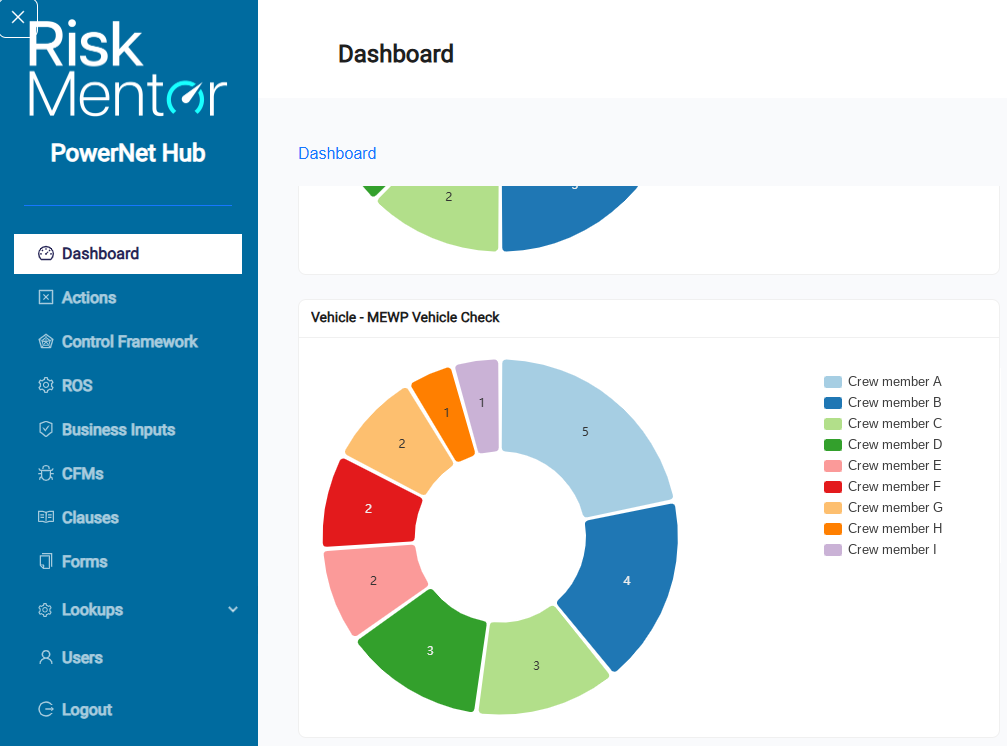
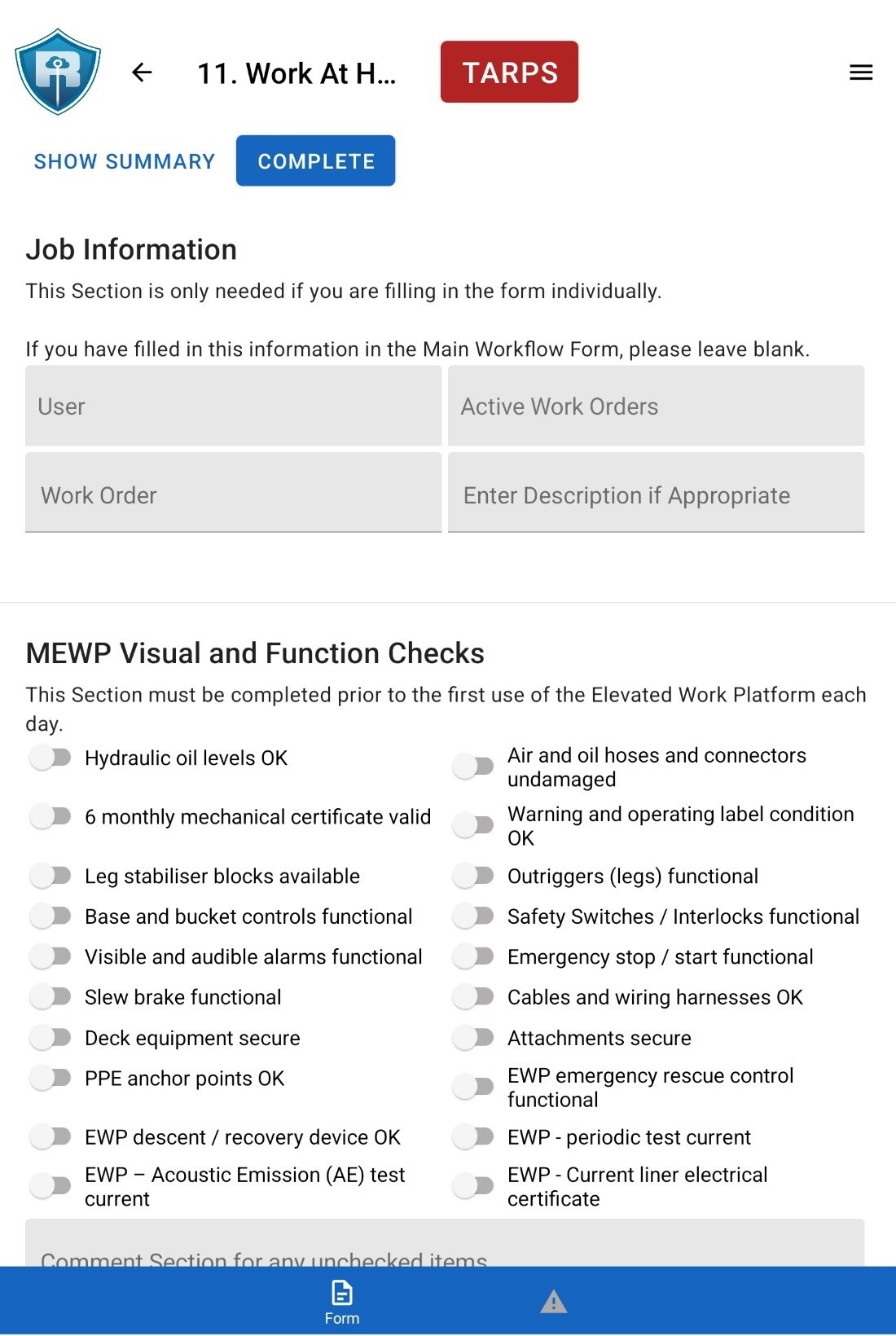
Elevating work platform checks by crew member, as the dashboard shows them. Names removed.
The leadership loop.
Four steps that repeat. The record of the work sits underneath every one.
- Set the standardYour frameworks, bowties and procedures say what has to be in place.
- Resource the crewsPeople, competency, equipment and time to meet it, confirmed at the task.
- Review the recordEvery job returns its record, read at every level from crew to board, with leaders testing a sample in the field. The test is an entry in the same record.
- Act on the differenceWhere the work and the standard differ, you see it, decide, and follow it through.
From 1 April 2027 the New Zealand officer duty has three limbs: understand, ensure and verify. Understand and ensure are largely about what is in place. Verify asks whether it was in place when the crew did the job. A record of the work is the most direct way to answer that.
How the loop closes
| Level | What they do | Ratio |
|---|---|---|
| Crews | Write the record at each step, as the work is done | Every task; about six critical-risk confirmations in each |
| Supervisors | Read the operational log for each task planned and executed, and act | One log per task, not every step |
| Managers and senior leaders | Check that supervisors are reading and acting, and test the record in the field | Patterns across crews; about 1 in 50 records checked in the field |
| Officers | Confirm the chain is working | The whole chain, at each review |
Not one for one: each level reads the one below at a coarser grain, and acts on what it sees. The record supports due diligence when every level does.
Set what you expect, and the record shows whether it was enough
Linked to the records you already hold, the record shows what was done. Set what you expect to see, and it shows the difference.
- CompetencyConfirmed for the task, every time it applies.
- Pre-use checksEvery vehicle and item of plant, before use.
- PhotographsWherever the workflow requires them.
- Leader field verificationsA sample: about 1 in 50 records.
One question worth asking: are your leaders checking the work your crews do most, or the work that is easiest to plan a visit around?
The argument, in brief.
Published October 2026 · New Zealand Journal of Health and Safety Practice, 3(3) · Peer reviewed
Due diligence – health and safety: a performance review, and what next?
Michael Boyle, Risk Mentor
- Every other officer duty, from solvency to tax to emissions, is discharged from records kept in the course of the work. Health and safety is the only one without them.
- Courts and guidance now ask officers how they know, not what they believe.
- A sample can test a ledger. It cannot be one.
- The answer is a record written as the work is done, booked against the standard it was performed to, owned by operations and read by safety: an operational ledger.
Kept to run the work. Read by many. Due diligence falls out of it.
How it works · For your safety and risk team
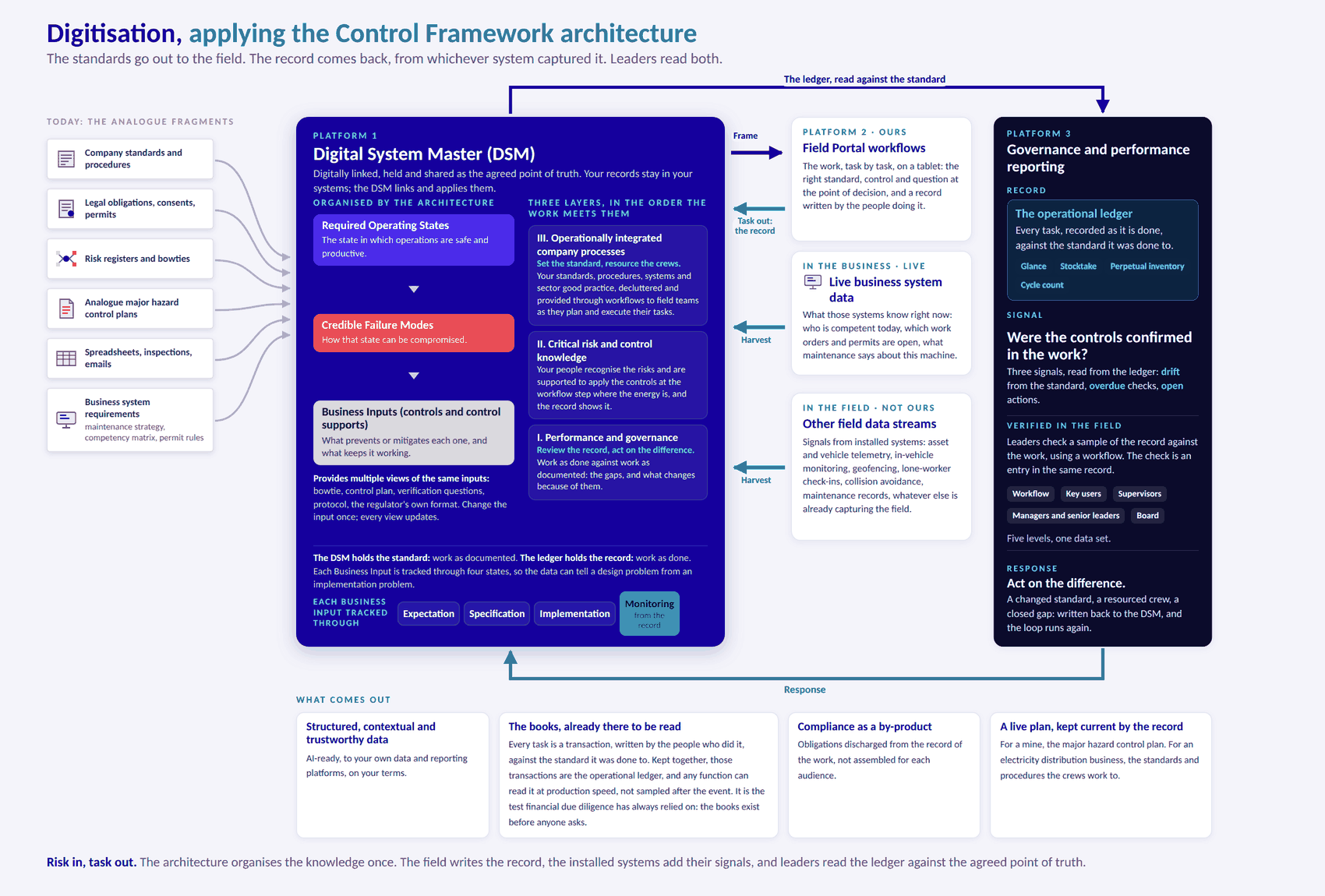
Digitisation, applying the Control Framework architecture
The standards go out to the field. The record comes back, from whichever system captured it. Leaders read both. The Digital System Master holds the standard: your standards, procedures and obligations organised once by the architecture and framed into field workflows. The ledger is the connected record, written in the field and read at every level. Click the diagram to enlarge.
Start from the state you need. Build from where you are.
The Control Framework asks three questions, in order. Each answer links to the next, many to many, and to the obligations it meets.
Every Business Input is written in four parts: the expectation (why), the specification (what), the implementation (how: training, maintenance, procedures) and the monitoring (how we know it happened). Each has an accountable owner.
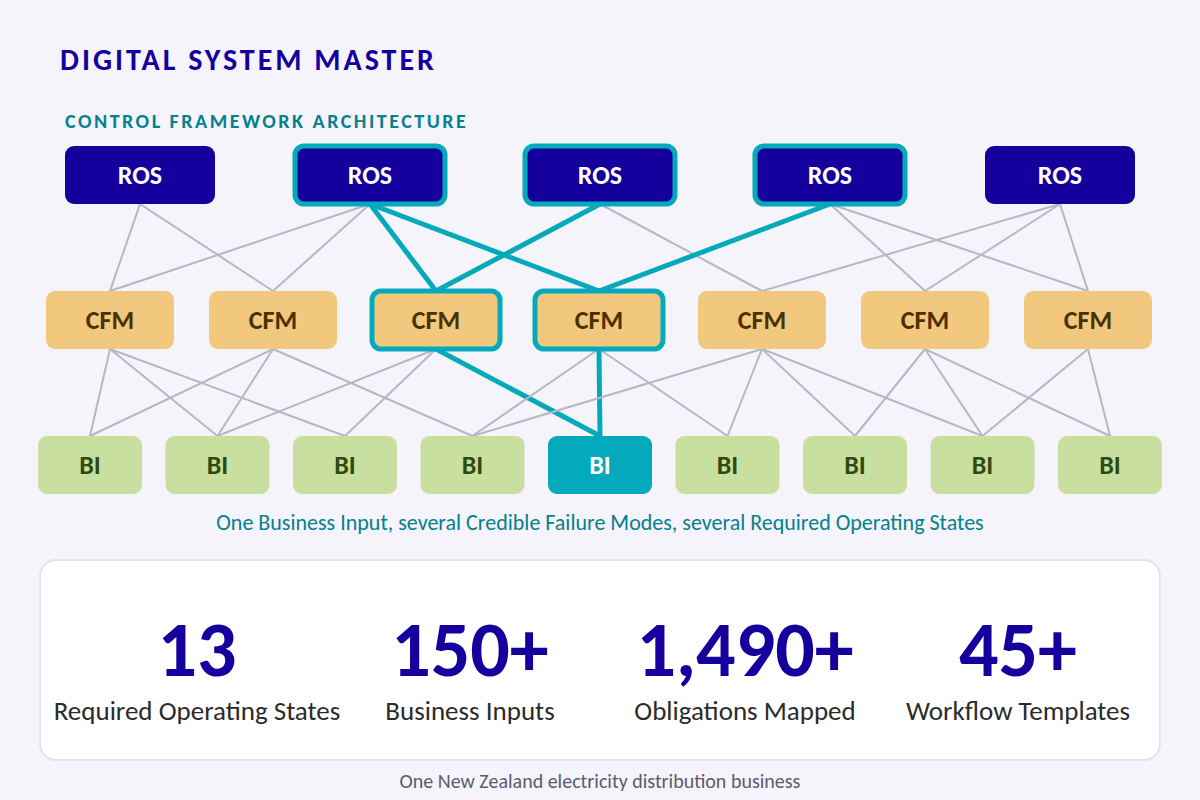
Written once, held in the Digital System Master as an agreed point of truth, and issued to every plan, procedure and workflow from there. Your records stay in your systems; the Digital System Master links them.
Paper systems had to ration attention to a short list of critical controls. A digital record doesn’t have to choose.
Not risk-in or task-out. Which comes first.
A risk-in approach works from the register toward the work, asking crews to report against a picture of risk decided in advance. A task-out approach works from the job: the crew plans and does the work, and the risk picture emerges from what they actually did, including signals no register predicted. The two belong together. The task records the work; the risk model reads that record.
Build the task-out foundation first, and everything already invested in risk and control gains the reliable data it was missing.
Questions we’re asked
Will my crews see this as being watched?
The first reader of every entry is the person who wrote it. They check their own work before anyone else sees it, and the record comes back to them when they sync.
Is this more paperwork for the field?
It replaces paperwork: the checklist beside the work, the procedure nobody reads at the point of use. One record, kept by the people doing the job, in a format that matches the way they already work.
What do my people get back?
A copy of their record, the know-how of their peers built into the workflow, and supervisors with more reach, who can see how the shift went without standing over it.
Does it work without signal?
Yes. The Field Portal works fully offline and syncs when the device reconnects. It has been in field use across several sectors for more than five years.
Can a crew complete a job plan in under two minutes?
They can plan the whole day in that time, then update it as the day changes. Simple, short tasks use a short form. More complex work adds only the steps it needs.
How many clicks to report a hazard or incident?
One, if the form is set as a screen default. Otherwise two: find it, open it. The form then moves through only the relevant fields.
Will crews actually use it?
Crews tell us it’s easier than paper. That includes people who find reading and writing hard, and people for whom English is a second language. It also brings them what they used to chase: work order numbers, their competency status, contractor pre-qualification.
Do we have to replace our systems?
No. Work orders, HR, training, contractor and asset systems stay. We connect to them, so the information reaches the crew at the task and the evidence comes back to where it’s useful. Bulk uploads from spreadsheets and databases are supported.
How do contractors fit in?
Contractors work to the same workflow and write to the same record. Pre-qualification status shows as a drop-down during task planning, so an unqualified contractor is visible before work starts.
Does verify mean more paperwork for officers?
No. The record is made at the work, by the person doing it. Reports to the board read the same records, so nobody re-tells them on the way up.
What do updates cost?
Platform updates are released several times a year and are included in the subscription. Changes to your workflows follow your own change process.
We deliver through contractors. Does this still work?
Yes. The five levels of governance are the same. What changes is that the asset owner has to secure across the contract boundary what an owner-operator gets for free, starting with the data coming back. The asset owner’s own duty can’t be contracted out. See Across the Contract Boundary.
How does this relate to Human and Organisational Performance?
PowerNet hasn’t run HOP as a programme. Over ten years it has built the operating system HOP describes: error-tolerant workflows, learning built into the work, and a response to weak signals that runs every week. See The Presence of Capacity.
The PowerNet briefing suite
Shared for sector benefit with PowerNet’s agreement. FY26 figures used with permission.
Request the working-at-height framework
The full framework for work at height on a distribution network: the Required Operating State, all 17 Credible Failure Modes, over 50 Business Inputs, and the regulations and standards each one meets. Free, by email.
Request the frameworkWho keeps your record of control performance?
Good management is having the standard and the resources in place. Due diligence is being able to show, across time, that you did.
A first conversation costs nothing. We’ll show you the record working at an electricity distribution business like yours.
Talk to Risk Mentor